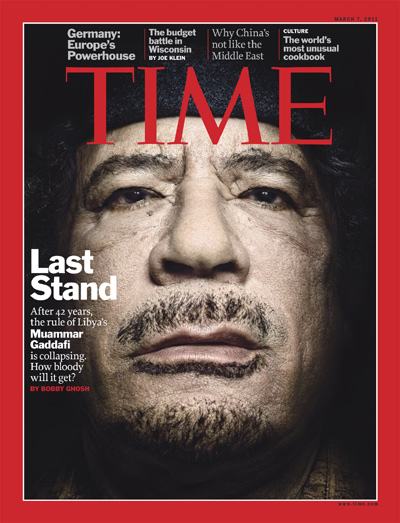
The Craziest Guy in the Room: A Portrait of Gaddafi

Three inches from one of the most notorious dictators in history, the photographer Platon focused tightly on the black eyes glaring at him through his lens. “There was nothing in them,” he said. “It’s like his soul had been scooped out of his head and taken away.”

The result, a dark and menacing portrait of Libyan leader Muammar Gaddafi, appeared on the cover of TIME International on newsstands last week. Platon captured the cold stare of the dictator in 2009 during the U.N. General Assembly while shooting a portfolio of world leaders for the New Yorker magazine.

Gaddafi, surrounded by a sea of female bodyguards, approached Platon, who had a small studio set up next to the stage. President Obama had just begun his speech and oddly, Platon said, this was when Gaddafi wanted to be photographed.

“It was scary,” Platon says. “He’s walking slowly towards me, like some kind of King. It was hellraising.”

Platon motioned towards the chair and Gaddafi stopped, considered it for a moment, and then nonchalantly sat down. “Everything was in slow motion, you could hear a bloody pin drop,” says Platon. “I’m whispering to him, ‘chin up,’ guiding him with my fingers. I’m so close it’s ridiculous.

“He was wearing this beautiful chocolate robe and his crazy wild hair is tamed by this sort of black pork pie hat,” Platon said. “And his eyes are just black slits, really hard to read anything. He’s either the smartest guy in the room or he’s the craziest guy in the room. It’s intimidating.”

Platon, who has photographed his share of daunting subjects that include Zimbabwe’s President Robert Mugabe, Venezuela’s President Hugo Chavez, Russian Prime Minister Vladimir Putin, and Iranian President Mahmoud Ahmadinejad, said Gaddafi was different. “He was vacant. There was no emotion, there was no spirit. It was void of something. When you come face to face with that it’s overwhelming, and that’s what I was trying to get in the picture.”

After the shoot, Platon said, “He put his hand on his heart to say thank you, and I did the same. And then, elegantly, he walked away.”

Platon then caught a glimpse of Gaddafi’s speech. “It was written in red crayon, in giant letters, like a six-year-old kid would write it. And it was written on about twenty pieces of tatty paper torn out of a book, in Arabic. It felt like notes of a madman.”

Patrick Witty is TIME’s International Photo Editor.

Related Topics: Gaddafi, Libya, Photography, Platon, Africa, arab uprisings, Dictatorships
  • Latest on Global Spin

    Oded Balilty / Reuters

    Netanyahu’s New Government: Warming to Peace Talks with the Palestinians?

    A flurry of gestures toward the Palestinian leadership suggests that Israeli Prime Minister Benjamin Netanyahu, in his new role as leader of a center-right government, is warming toward the resumption of peace talks — or at least giving the appearance of warming; call it a rosy glow rising from a pair of announcements on Monday. One was about Palestinian prisoners who had been carrying out a mass hunger strike for weeks inside Israeli prisons. With several prisoners near death, Netanyahu approved an agreement that improves prison conditions and permits visits by family members in the Gaza Strip, the heavily guarded enclave that Palestinians have been allowed out of only for medical emergencies. Greeted by Palestinians as a victory, the deal eased concerns that a prisoner’s death might combust what are usually routine protests planned for Tuesday’s commemoration of Nakba Day, the “catastrophe” of Israel’s 1948 victory over Arab forces trying to prevent the establishment of a Jewish state.

    Bernat Armangue / AP

    Palestinians Mark Their Day of “Catastrophe”

    Protesters challenge Israeli troops in the West Bank while commemorating the Nakba, or “day of catastrophe” in Arabic, which marks the day when Israel declared its statehood in 1948—an act which forced thousands of Palestinians out of their homes and into a life of exile

    Christopher Furlong/ Getty Images

    Rebekah Brooks, Husband Charged in Phone-Hacking Scandal

    The convoluted saga of the British phone-hacking scandal seems to have been dragging on longer than a back-to-back performance of Wagner’s Ring Cycle. Yet despite the demise of Rupert Murdoch‘s News of the World, the launching of a public inquiry into British press standards, three police investigations and more than 40 arrests, the scandal has yet to draw real blood. The closest it has come was a report released this month by a Parliamentary committee, which accused Murdoch of turning a blind eye to the hacking at his paper and declared him “not a fit person” to run an international company — a damning conclusion that nonetheless seems to have had little immediate effect.

  • deconstructiva

    “The Craziest Guy in the Room”: Bethany McLean and the guys at Enron would be proud of how the original book / movie title would make the social dictionary and cross over to other analogies, but I would’ve guessed Gaddafi used green crayons to write speeches, not red ones.

blog comments powered by Disqus