


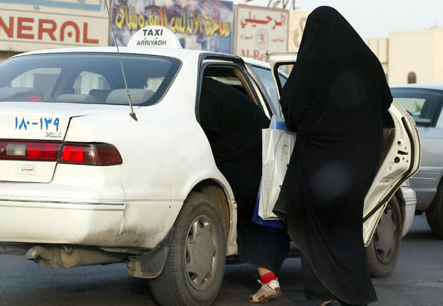
Hassan Ammar/AFP/Getty Images
If a group of Saudi activists get their way, this Friday June 17 will mark the start of Women2Drive, a campaign to get the country’s women behind the wheel. The call to action came after the arrest and detention Manal al-Sharif, a 32-year-old tech specialist, who last month posted a YouTube video of herself driving a car. Saudi Arabia maintains a system of gender-segregation that effectively prohibits women from driving. The de facto ban leaves women dependent on male relatives or paid chauffeurs, even in emergencies. Many, like al-Sharif, are fed up: “I’m doing it because I’m frustrated, angry and mad,” she said.
Her act of defiance inspired women across the country and, indeed, around the world. In the days and weeks following her arrest, Saudi women formed Facebook groups, started a Twitter feed and posted guidelines for women wanting to take part. A consortium of rights groups wrote an open letter to Hillary Clinton. “In the context of the Arab Spring and US commitments to support nonviolent movements for democracy, now is the time for US leaders to show their support for Saudi women’s rights,” it says.
Of course, the timing is tricky. The revolutions in Egypt and Tunisia have inspired the country’s would-be activists, but have emboldened authorities too. Spooked by calls for a Saudi ‘Day of Rage,’ the country’s cadre of princes has moved swiftly to buy loyalty and quash dissent. King Abdullah, who, incidentally, has expressed tepid support for the idea of women driving, recently spent billions on bonuses for government workers and public works projects. His family also reached out to religious authorities, lavishing $200 million on various organizations. Religious groups in turn declared protests anti-Islamic. “Conservatives are angling for their own pound of flesh,” wrote TIME’s Aryn Baker in recent dispatch from Riyadh. “So while the king might be making all the right noises about helping women become full members of Saudi society, other forces are pulling them back.”
With ongoing instability in the region and in-fighting among the elite, it will be interesting to see how the state, and women, respond to calls for protests. So far the reaction from the state has been firm, but measured (by Saudi standards), with no reports of violence. Manal al-Sharif, the woman who posted the driving video, was detained for almost two weeks and forced to sign a statement saying she wouldn’t drive again. On Friday, police arrested six more women for driving on an empty plot of land north of Riyadh. Their fathers had to bail them out.
It’s impossible to know, yet, how many more will join the campaign, or what impact the movement could have. In an essay for the New York Times, Iranian-American scholar Farzaneh Milani takes a long view:
It may require decades to see an end to the Middle East’s gender apartheid and the political reconfigurations that would necessarily follow. One thing is certain though: the presence of women and men demonstrating side by side in the streets of Iran, Tunisia, Egypt, Bahrain, Yemen and Syria is a sign of more seismic upheavals ahead. Old categories have broken down and the traditional distribution of power and space is no longer viable.
The women demonstrating for the right to drive in Riyadh are seasoned negotiators of confined spaces and veteran trespassers of closed doors and iron gates. They are a moderating, modernizing force to be reckoned with — and an antidote to extremism.
Their refusal to remain silent and invisible or to relinquish their rights as citizens is an act of civil disobedience and moral courage. Their protest, and those of their sisters across the Middle East, represent a revolution within revolutions — and a turning point in the contemporary history of Islam.
In this sense, the protests are part of a bigger project, one that includes women and men: the fight for self-determination.