


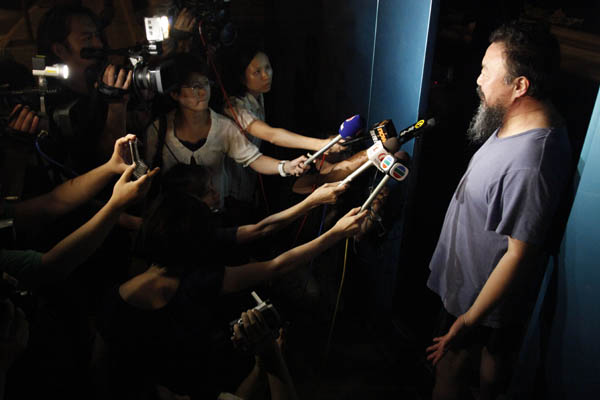
Journalists attempt to interview activist artiste Ai Weiwei outside his home after he returned from detention in Beijing, China, Wednesday, June 22, 2011. (Photo: Ng Han Guan / AP)
UPDATE: News outlets including the New York Times confirm that Ai Weiwei has been released.
Ai Weiwei, the Chinese contemporary artist and outspoken government critic who has been held by police in Beijing since April 3, was released on bail on Wednesday, according to a report by China’s state-run Xinhua news service. Police released Ai, 54, because of “his good attitude in confessing his crimes as well as a chronic disease he suffers from,” Xinhua reported.
Liu Xiaoyuan, a lawyer who has represented Ai, posted on Twitter that Ai responded to a text message at 11 p.m. confirming that he had been released. Calls to Ai’s phone went unanswered. His sister told Reuters that he had yet to return home and she didn’t know his whereabouts. “There are these rumors that he has been let out on bail, but we haven’t heard anything yet,” Gao Ge told Reuters by telephone.
Ai was arrested on April 3 at the Beijing airport while attempting to fly to Hong Kong for work. His was the highest-profile detention in a crackdown on dissent that was triggered in part by government fears that the revolutions in Tunisia and Egypt could inspire protests in China. His lengthy detention drew international criticism. While police eventually said Ai was being investigated for “economic crimes,” including tax evasion, it was widely believed that he was targeted for his outspoken criticism of the Chinese leadership. Ai, the son of an iconic poet and the designer of Beijing’s Bird’s Nest stadium, denounced the government over the deaths of children in schools that collapsed during the 2008 Sichuan earthquake and wrote extensively on his blog and Twitter account about cases of official corruption and wrongdoing.