


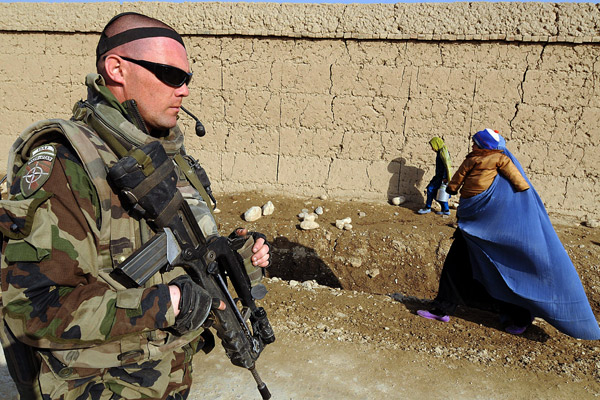
A burqa-clad Afghan woman walks past a French soldier with the NATO-led International Security Assistance Force (ISAF) during a patrol on the outskirts of Kabul. (Photo: Shah Marai / AFP / Getty Images)
Just hours after U.S. President Barack Obama announced his timetable for withdrawing troops from Afghanistan, his French opposite Nicolas Sarkozy followed suit by revealing Paris’ plan to also gradually bring soldiers in its Afghan contingent home. The swiftness of Sarkozy’s decision—which clearly followed consultation with Obama—seems certain to provoke a flurry of other capitals involved in Afghanistan doing likewise.
France unveiled its plans to start pulling back its 4,000-odd force in Afghanistan early Thursday morning, shortly after Obama’s Wednesday night announcement he’ll undertake a three-phase draw-down of the 100,000 U.S. forces in Afghanistan, involving a total of American 33,000 soldiers by September, 2012. Unlike the Obama plan, the Elysée communiqué did not detail numbers or timing of Paris’ planned withdrawal, though it did say it would be “in a proportional manner comparable to the withdrawal of American troops”. It also made it clear France continues working hand-in-glove with Washington on Afghanistan—and concurs with White House views motivating the reduction of forces.
“France shares the American analysis and objectives, and applauds President Obama’s decision,” the Elysée statement read. “Taking into account recent progress achieved, (France) will undertake a gradual withdrawal of its forces in Afghanistan.”
German officials also acted warmly Thursday to the Obama withdrawal decision—a move that appears to justify Berlin’s earlier decision to start scaling back Afghan deployment to just under 5,000 this year. Given his cost-cutting elsewhere—and increasingly contested decision (along with Sarkozy, Obama, and other Western leaders) to commit UK forces to the Libyan intervention—it’s likely British Prime Minister David Cameron may make a similar draw-down announcement for Afghanistan soon as well.
But while countries participating in the NATO-led Afghan mission will doubtless jump at the chance to scale back their involvement in an expensive war that has gradually lost the early over-whelming support of publics and politicians alike, pains will be taken to avoid giving any impressions of cutting and running—or eagerness to abandon American forces and Afghan civilians in the conflict. Paris, in particular, doesn’t want to hear any more Iraq-era jabs about “cheese-eating surrender monkeys”.
“France will remain fully engaged with its allies at the side of the Afghan people to take the transition process to its end,” the Elysée communiqué noted. “The transition process (shifting) security responsibilities to the Afghan authorities will continue until 2014.”