


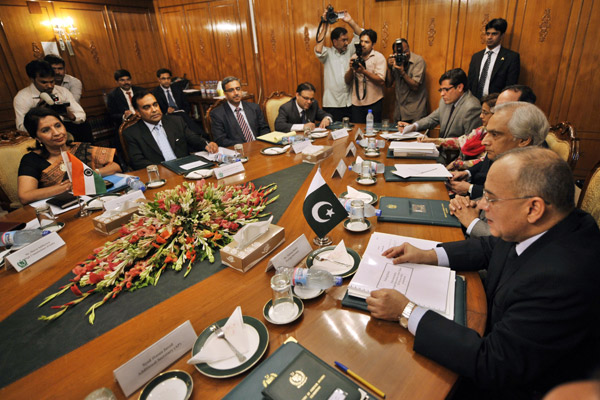
Indian Foreign Secretary Nirupama Rao holds talks with her Pakistani counterpart, Salman Bashir, during a meeting at The Pakistan Foreign Ministry in Islamabad on June 23, 2011. (Photo: Aamir Qureshi / AFP / Getty Images)
The Pew Center has a fascinating new poll out this week measuring public opinion in Pakistan. Among the most surprising results is the degree to which Pakistanis’ view of India have deteriorated over the last several years:
“Pakistani views of traditional rival India have grown increasingly negative in recent years. Three-in-four express an unfavorable opinion of India, up from 50% five years ago. When asked which is the biggest threat to their country, India, the Taliban or al Qaeda, a majority of Pakistanis (57%) say India.”
Indian opinion of Pakistan is not much better:
“Similarly, Indians express negative opinions of Pakistan; 65% have an unfavorable view of their traditional rival and more name Pakistan as India’s biggest threat (45%) than name Lashkar-e-Taiba (19%) or Naxalites (16%).”
The study is revealing about both countries. Despite dozens of deadly attacks blamed on Taliban- or Al Qaeda- linked groups over the last several months, Pakistanis still believe that India poses a greater threat to their safety. The idea persists that India is somehow behind those attacks, or that is fomenting unrest and instability in Balochistan – a view that is widely held in Pakistan despite the lack of any credible evidence so far. As I noted in an earlier piece on India and Afghanistan, “Islamabad claims that India’s four consulates are bases for espionage and for funneling aid to separatist rebels in the Pakistani province of Baluchistan.” In an interview with my colleague Aryn Baker, the former Pakistani President Pervez Musharraf said he is convinced that New Delhi is responsible for providing Baluchi insurgents with weapons. “The Afghans have nothing,” he said, “so it must be the Indians.” Indians, meanwhile, seem to conflate Lashkar-e-Toiba and Pakistan as one. The recent Rana-Headley trial and intense media coverage of David Headley’s testimony that ISI was involved in planning the attacks, have surely influenced that result.
Other results from the survey, which was conducted after the U.S. raid that killed Osama bin Laden, were less surprising: opinion of the U.S. in Pakistan is as low as it has ever been; 63% of Pakistanis disapproved of the operation that killed bin Laden; and most Pakistanis, like the rest of us, are uncertain about how much their own government knew about bin Laden’s life in Abbotabad or the operation that ended it. There’s also a clear indication of the challenges that the U.S. will face going forward in Pakistan — the military enjoys a much more favorable rating than the civilian government. Also not surprising: the Pakistani government has rejected the poll’s findings as “a malicious exercise to malign Pakistan’s politicians, to undermine its democracy, and to wrongly portray the Pakistani people’s courageous fight against terrorism.”