


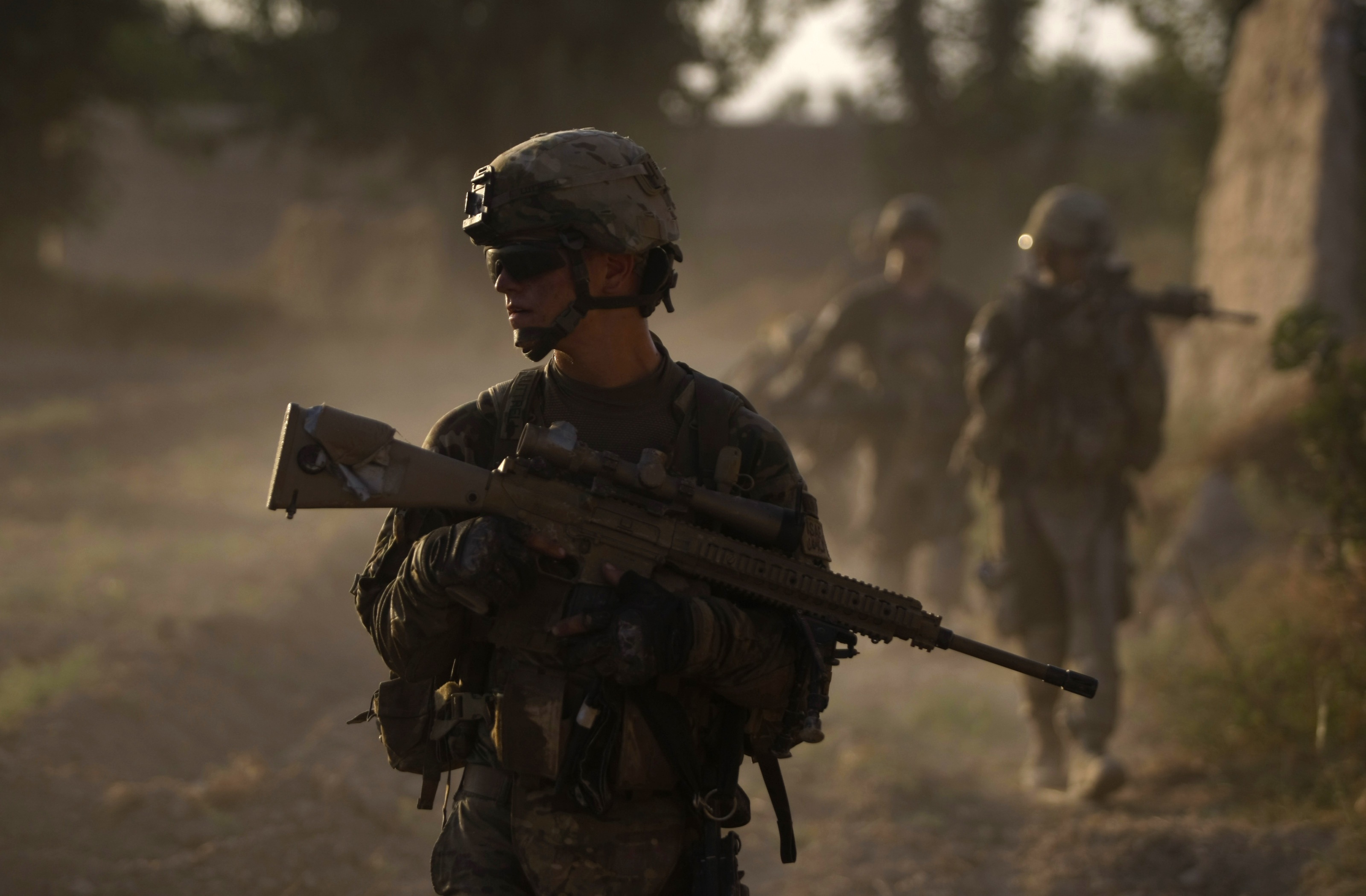
U.S. army soldiers on patrol in the Panjwai district of Kandahar province in southern Afghanistan. (Photo: REUTERS / Baz Ratner)
If President Obama’s plan for withdrawal demonstrated the unusual feat of simultaneously pissing off both sides of the aisle in the US, he need not despair: in Afghanistan he most certainly drew applause from both the Taliban, and Karzai – who crowed in an interview with CNN on Sunday that even if things got really bad, he would never ask for more troops. That might make several U.S. lawmakers sigh in relief, but it underscores the dangerous levels of hubris piled onto the Afghan debate.
We may now have a timeline that satisfies mounting US demands to pull out of what is rapidly becoming a multi-billion dollar money pit, but we have also reconfirmed to the Taliban and other Afghan insurgents that if they can hold on just a little bit longer, the country will be theirs again. So where is the incentive to negotiate?
Sure, things are pretty tough for the Taliban in Afghanistan’s southern provinces of Helmand and Kandahar right now, but Obama’s confidence in the Afghan people’s ability to “be responsible for their own security” by 2014 rings hollow. As a new report by the International Crisis Group points out, central Afghanistan is ripe for the taking.
Despite efforts to combat the insurgency in the south, stability in the centre has steadily eroded. Yet, with nearly one fifth of the population residing in Kabul and its surrounding provinces, the Afghan heartland is pivotal to the planned transition from international troops to Afghan forces at the end of 2014……
In the rural areas of Ghazni, Wardak, Logar and other nearby provinces, where unemployment runs high and government presence is low, the insurgency has found safe havens far from the borders of Pakistan. ….Following the announcement by President Barack Obama on 22 June 2011 of U.S. plans to withdraw 33,000 troops by September 2012, it appears likely that the insurgency will push forcefully to gain more ground before the military drawdown reaches its final phase by December 2014.
Not only that, but withdrawing forces at the proposed pace means hard decisions to come. Do the bulk of US forces stay in the south to consolidate those gains, even though the southern Taliban have had very limited affiliation with al Qaeda and international terror groups? Or do they pivot to the east, where the openly pro-al Qaeda Haqqani network has dug in, by grace of Pakistan’s inability, or unwillingness, to take them on?
I’m not saying that keeping troops in Afghanistan is the solution. At this point, having covered Afghanistan for the better part of our involvement there, I am not sure what the strategy should be. It would be much easier to say what our strategy should have been: less reliance on warlords, less throwing cash around, and more focus on the small things that build stability, such as education and a functioning justice system.
And while there has been some progress in the development and training of the Afghan security forces, they are unlikely to be able to combat the insurgency on their own if their progress is not matched by concomitant advances in governance. As the old counterinsurgency adage goes, it’s not that the enemy is strong, but that the government is weak.
So we can talk all we want about reconciliation with the Taliban, plans for withdrawal and building up an indigenous Afghan security force, but it amounts to nothing if we don’t address the elephant in the corner. You know, the one in the dashing striped cape and karakul hat who was once dubbed by Tom Ford the “most chic man in the world.”
Foreign Affairs editor Gideon Rose, in his NYT op-ed piece Saturday, proposed that Obama follow Nixon’s strategy in Vietnam, or at least the strategy he would have followed had the pesky issue of wiretapping and possible impeachment not got in the way. That strategy of course, “exiting the Vietnam War by masking their withdrawal with deliberate deception and aggressive covering fire” was based on dissembling and doubletalk, something Nixon was rather good at. It’s an interesting, if Swiftian, proposal. But what is more alarming is the conversation about withdrawal between Nixon and Kissinger that Rose quotes at length:
Nixon: “Let’s be perfectly cold-blooded about it…. I look at the tide of history out there, South Vietnam probably is never gonna survive anyway…. [C]an we have a viable foreign policy if a year from now or two years from now, North Vietnam gobbles up South Vietnam?”
Mr. Kissinger replied that American policy could remain viable if Saigon’s collapse “looks as if it’s the result of South Vietnamese incompetence. If we now sell out in such a way that, say, in a three- to four-month period, we have pushed President Thieu over the brink…. it will worry everybody… So we’ve got to find some formula that holds the thing together a year or two, after which… no one will give a damn.”
All the talk of withdrawal strategies in Afghanistan, whether they be troop pullouts, reconciliation or a combination of both, neglect to discuss what we, and Afghans, want the country to look like on January 1, 2015. Or, according to Kissinger’s logic, a year or two later, “after which… no one will give a damn.”
Maybe, or maybe not. Even if Afghanistan dissolves into another civil war, al Qaeda is unlikely to return to its old stomping grounds – there are much more tantalizing prospects in Somalia and Yemen. But a civil war in Afghanistan is a proxy war for the region, and unlike the early 90s, the stakes are higher. Pakistan and India have nuclear weapons. Iran might. Russia and China will fight for access, and resources. It’s hard to see how the US wouldn’t give a damn then.