


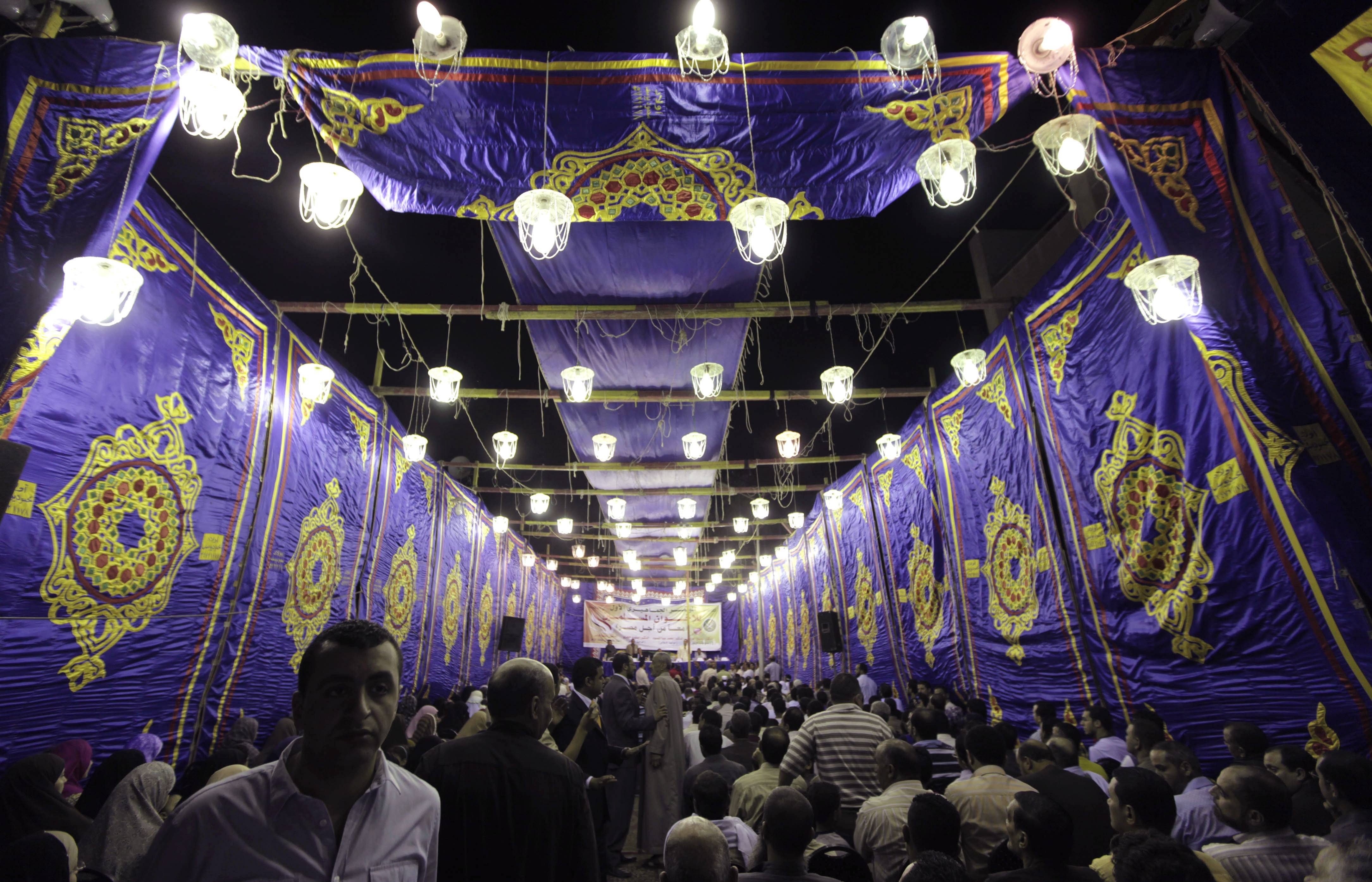
Members of the Muslim Brotherhood attend a rally in Cairo's Munib neighborhood (Photo: Nasser Nasser / AP)
Most Western observers see the Muslim Brotherhood as a homogenous group of hard-line Islamists, dedicated to overthrowing the secular Egyptian state and imposing a severe interpretation of Shari’a law on its people. In reality, the Islamist group has long been something of a “big tent,” gathering within it representatives of different political leanings, all united by oppression under the regime of Hosni Mubarak.
In conversations, some Brothers come across as old-fashioned leftists, dare I say even Marxists: their main focus seems to be workers’ rights. Others have an almost Thatcherite disdain for labor unions. Even among the true-green Islamists, there are at least two different groups: the followers of Hassan Banna and those of Syed Qutb. (I’ll save a discussion on the distinctions for another day.)
With the brutal oppression of Mubarak now gone, it’s only to be expected that some denizens of the big tent feel free to strike out on their own. Some slipped away quietly, casting their lot with liberals like Mohamed ElBaradei and Amr Moussa. Others, like Abdel Moneim Aboul Fotouh, broke with more fanfare: after he defied the Brotherhood’s ban on any member’s standing for President, he was ejected from the party.
Now a group of prominent young Brothers have decided to go their own way, setting up the Egyptian Trend Party. (The Brotherhood, which has its own political arm, the Freedom and Justice Party, has said that those who join the new group will be expelled.)
This was to be expected: a couple of days before the announcement of the new party, Mohamed Kassas and Islam Lotfy told me they were disenchanted with the Brotherhood’s senior leadership. “The revolution exposed major differences between older and younger Brothers,” said Kassas. While the younger members were keen to join the uprising against Mubarak from the get-go, the older leadership were wary. Perhaps because they had suffered terribly for resisting the regime (most of the Brotherhood leadership endured long years in jail and brutal torture), the old guard hesitated for several days as the anti-Mubarak momentum built up in Tahrir Square.
The leadership eventually backed the revolution, but by then they had lost credibility among many young members. Those young Brothers who had already joined the crowds in the square found themselves — for the first time without “adult” supervision — having conversations about politics with non-Islamist peers. They discovered shared aspirations. “They wanted the same things we did, like freedom and the right to change the government,” Lotfy told me.
After Mubarak’s fall, the young Brothers were disappointed by their elders’ initial actions. The Brotherhood’s political party was created overnight, with little discussion; the youth wing would have preferred an internal election to determine the leadership of the new body. “There’s not enough distance between the Brotherhood and the party,” said Kassas. The dismissal of Aboul Fotouh was the last straw.
Launching their own party, Kassas and Lotfy have said they will uphold the aspirations of the Tahrir throngs. But while they are long on ambition, they’re short on specifics about how they would like the new Egypt to be governed. Their party will seek to build a new big tent, inviting liberals and leftists to join.
Guess who’s doing the same thing? Yes, the Brotherhood, too, wants to form a broad coalition ahead of the parliamentary elections scheduled for the fall.