


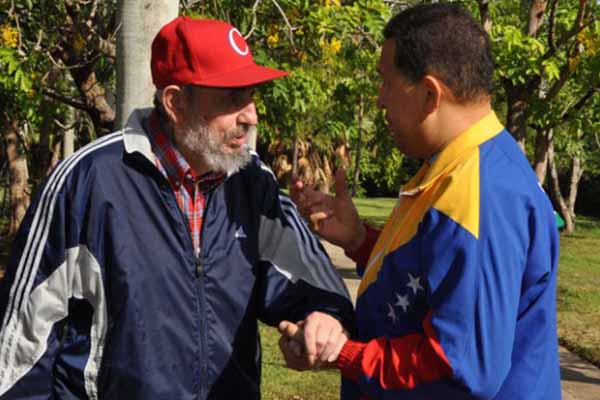
Former Cuban leader Fidel Castro and Venezuela's President Hugo Chavez (R) speak in Havana in this June 28, 2011 (Photo: Revolution Studios / Reuters)
It’s hard to imagine Hugo Chávez missing July 5. El cinco de julio was going to be a confluence of everything the socialist Venezuelan President lives for politically: It’s Venezuela’s bicentennial, a chance for Chávez to revel in the aura of his Bolivarian Revolution’s namesake, 19th-century South American independence hero Simón Bolívar. And it’s the day he was set to host the inaugural summit of the Community of Latin American & Caribbean States (CELAC), a hemispheric body that pointedly excludes his imperialista enemy, the U.S.
But late afternoon today, June 29, the Venezuela Foreign Ministry said next week’s two-day CELAC gathering on Margarita Island had been suspended. The reason: “the recuperation process and the extremely strict medical treatment” that Chávez, 56, is undergoing in Cuba after his June 10 surgery there for a pelvic abscess. Officials in Caracas also released a video of Chávez walking, talking and looking alert as he visited with former Cuban leader Fidel Castro on Tuesday. “These images should bring calm to the Venezuelan people about the President’s health,” said Information Minister Andrés Izarra. Still, they didn’t say if Chávez would be back in time for the bicentennial celebration. Either way, the CELAC summit postponement sent shock waves through Venezuela and the western hemisphere, where speculation about Chávez’s condition is rife due to what until a few days ago had been unusual silence from him and his government.
(Read “With Hugo Chávez Hospitalized, Venezuela Frets About the Future”)
Venezuelan pundits like Chávez biographer Alberto Barrera tell me their initial guess is that el comandante will return by July 5 to at least be present for the bicentennial – given how badly his absence for that event could deflate his stature in advance of his re-election bid next year, and how robustly his return for it could puff him up. “He has to be in Venezuela that day,” says Barrera, whose book, Hugo Chávez, written with his journalist wife Cristina Marcano, takes a more critical look at Chávez’s trajectory from failed coup leader to fiery head of the hemisphere’s most oil-rich state. “It’s the moment he’s planning to declare, in his usual grandiose way, that his revolution has fulfilled all of Bolívar’s dreams for Venezuela and Latin America.”
If Chávez isn’t there on the 5th, however, Barrera says the psychological effect will be deep. “The country will feel all the more vulnerable and paralyzed,” he says, “because Chávez has built a personalista state that revolves solely around him.” Should Chávez’s condition not only keep him from the bicentennial but even prevent him from running for another six-year term in 2012 – it would be his fourth race after winning in 1998, 2000 (special election) and 2006 – it would greatly bolster his wobbly opposition’s chances and likely spark chaos inside his United Socialist Party, where few dare speak of grooming his successor but which is more fraught with divisions than Chavistas would ever admit. (Simon Romero has a good article in today’s New York Times about the possibility that Chavez’s older brother, dyed-in-the-wool Marxist Adan Chavez, could take Hugo’s place, much as Fidel Castro’s younger brother Raúl did in 2006 when intestinal surgery sidelined Fidel.)
Meantime, the Venezuelan opposition insists that Chávez, after almost three weeks, can’t keep pretending to run his government from a hospital bed in Havana, especially with crises like high inflation, power outages and a major prison riot harassing the country at the moment. In Chávez’s absence, the anxiety among Venezuelans and the seeming paralysis within Venezuelan officialdom prove two things – that his populist popularity with a broad swath of Venezuelans is still intact, but also that Venezuelan government is inordinately focused on the caudillo-like personality of one man. Where that system goes from here may depend a great deal on whether Hugo Chávez goes home in time for el cinco de julio.