


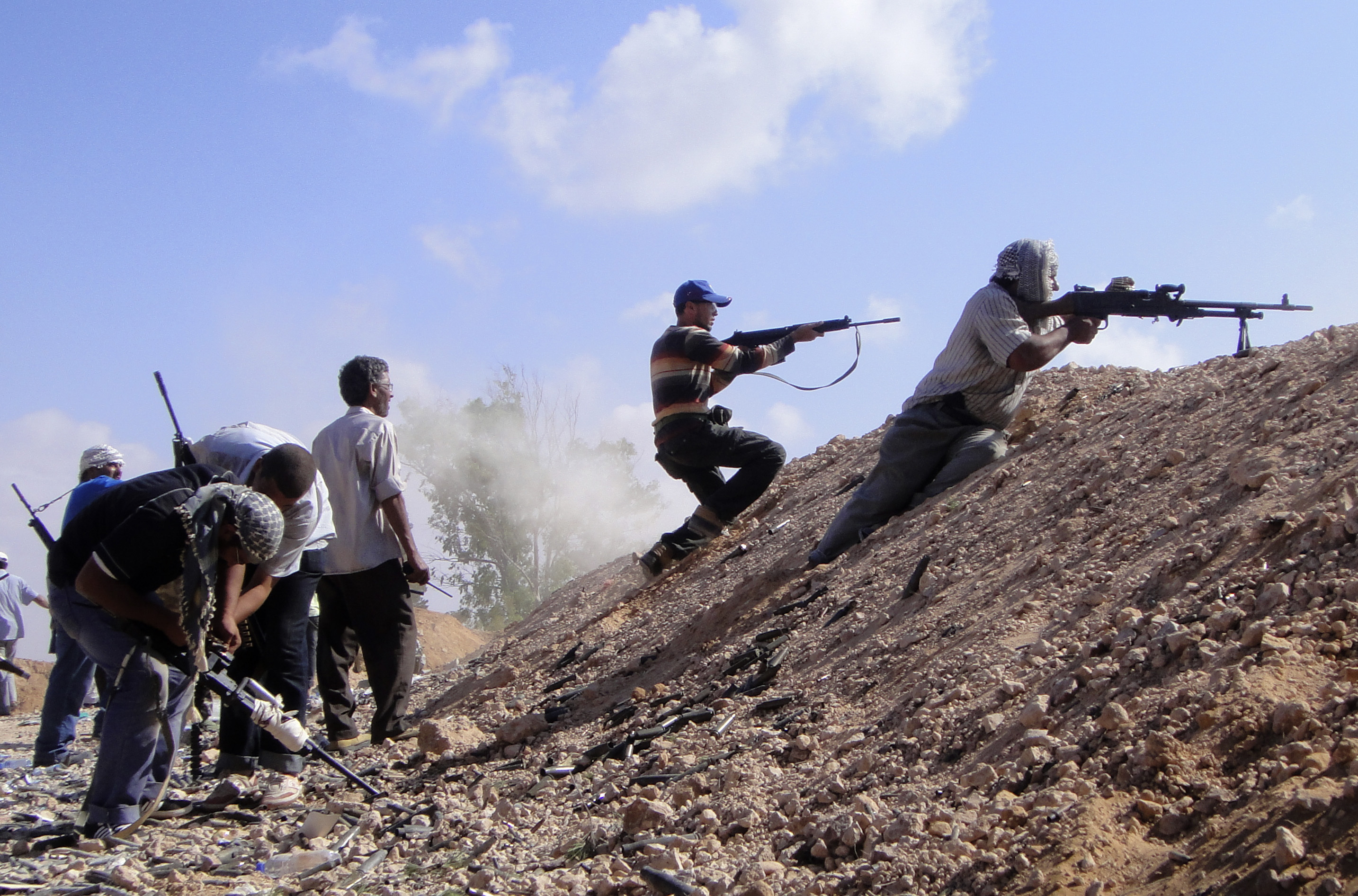
Libyan rebel fighters fire their machine guns towards pro-Gaddafi forces on the front line of Dafniya in Misrata, Libya, Tuesday, June 21, 2011. (Photo: Abdel-Kader Fassouk - AP)
U.S. President Barack Obama soon won’t be alone in taking flack about the legality of certain moves he’s made on Libya. On Wednesday, French military officials confirmed press reports that France has dropped arms and ammunition to Libyan rebels in what will doubtless spark protests that such action violates limitations the United Nations mandate set for the NATO-led air intervention. It’s also likely to further raise fears in the Arab world that the international operation it initially backed to prevent the slaughter of Libyan civilians is steadily escalating towards full and active foreign intervention in yet another Muslim country.
Several press reports emerged Wednesday afternoon in the wake of a daily le Figaro story reporting France had air dropped guns and ammo in Libya earlier this month. That prompted French military officials to acknowledge to the Associated Press that initial drops of food and humanitarian assistance to civilians had evolved into parachuting “self-defense assets—which is to say weapons and munitions” to rebel fighters. Those included, AP and other reports say, “assault weapons, machine guns, rocket-propelled grenades and munitions”. That confirmation, NATO officials state, is the first public recognition of a Western member of the operation supplying arms to forces battling Libyan leader Muammar Gaddafi.
Given the countless bombs NATO planes have dropped on Gaddafi’s military assets (and, on occasion, anti-Gaddafi fighters and civilians) in the four-month campaign, news of France now supplying guns to rebels for use in their ground war might not sound all that audacious, much less illogical. However, NATO members themselves are deeply divided over whether arming anti-Gaddafi militants is permitted under the U.N. resolution that approved the air intervention—a defensive measure explicitly aimed at preventing advancing Gaddafi loyalists from slaughtering unarmed civilians. Beyond the legal questions involved, countries like Italy and Germany have also hotly contended arming rebel fighters would amount to pouring gas on an already blazing and deadly civil war—and risk seeing such weapons wind up in the hands of anti-Western jihadist forces also present in the region.
Rome and Berlin have also contested earlier—and rather coy–comments by France and Britain that arming Libyan rebels would not violate the U.N. mission mandate. That position will almost certain be put to the legal test from dissenting partners now there’s been confirmation weapons have been quietly air dropped into Libya for a month now. Vexation over that news will presumably be all the greater given France’s earlier disingenuous balancing act claiming that while arming Libyan rebels wouldn’t be illegal, French officials were still generally against the idea.
The resulting calls of foul out of Europe probably won’t be the only ones to resound in the wake of Wednesday’s news. Arab nations whose initial support was essential in getting the original U.N. resolution approved have since grown to regret backing an operation that—many claim—has escalated to the point of resembling hated Western wars in Iraq and Afghanistan. Earlier this month, Amr Moussa, head of the Arab League, admitted to The Guardian his “misgivings” about the ongoing NATO mission claiming ever more innocent civilian lives as the ferocity of it bombing raids increases. Such concerns will only rise in the Arab world now that the French announcement makes it clear the escalation of violence is also being fueled on the ground—and by safe, remote proxy.
“We’d never get the necessary support from Arab nations now if the original UN vote were held again today,” a French diplomat said prior to Wednesday’s news of arms drops. “We still believe the intervention was the right thing to do to prevent mass slaughter, and we’re still certain this conflict will end with Gaddafi out of power and the Libyan people free to determine their own future. But it’s incontestable that as far as the war of PR and global public opinion is concerned, we’re not in the best place we could be”.
As of this afternoon, that diplomat can certainly say that again.