


Riot policemen arrest a protester during clashes in central Athens Wednesday, June 29, 2011. (Photo: Petros Giannakouris / AP)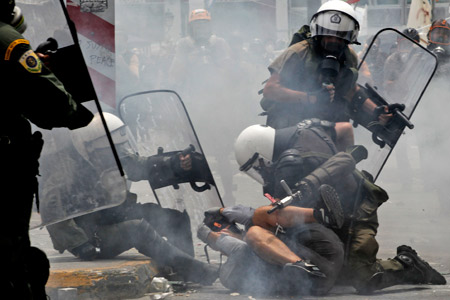
As Greece withstands the second day of a 48-hour general strike shutting down much of the country, it’s worth considering the history of this radical, dramatic tactic. The pervasive feeling in the debt-ridden Mediterranean country seems to be a sense that something has altogether broken in their society. One middle-aged Greek told TIME contributor Joanna Kassisis: “I am tired of this country being the easy target. Let Greece go bankrupt. Let all of Europe go bankrupt. I want them to stop bleeding me for money I just don’t have.” For countless workers and ordinary citizens, the austerity measures being voted on today offer little hope of succor. Their protests, as my colleague Tony Karon pointed out yesterday, present an important rejection of the economic consensus that has shaped Europe for much of the last few decades.
A general strike marks that sort of fundamental challenge to the status quo—a moment when a vast cross-section of a community, or city or country decide that enough is enough. While few strikes of such a mass scale occurred in the U.S., the general strike as a moral, political weapon was cogently argued for by Bill Haywood, the Utah-born, larger-than-life organizer for the once influential Industrial Workers of the World union in the early 20th century:
The capitalists have wealth; they have money. They invest the money in machinery, in the resources of the earth. They operate a factory, a mine, a railroad, a mill. They will keep that factory running just as long as there are profits coming in. When anything happens to disturb the profits, what do the capitalists do? They go on strike, don’t they?… They close it down because there are no profits to be made there…. But the working class, on the other hand, has always been taught to take care of the capitalist’s interest in the property. You don’t look after your own interest, your labor power, realizing that without a certain amount of provision you can’t reproduce it. You are always looking after the interest of the capitalist, while a general strike would displace his interest and would put you in possession of it.
In that vein, as Greece shakes, here are some important general strikes to remember:
Russia, 1905: In coordination with liberals and socialists, a majority of Russia’s industrial workers went on strike — perhaps as many as 2 million people — bringing the country’s railroads to a screeching halt and compelling the Tsar to implement the October Manifesto, a more liberal constitution. A decade later, renewed strikes and unrest would lead to the Bolshevik Revolution.
India, 1946: Sailors and longshoremen aboard British India’s ships and across its many ports all took to strike, a reaction against their general working conditions, but also a move that meshed with the popular desire for independence from the weakening British empire. The strike was one of the main tipping points on India’s road to freedom.
Algiers, 1957: Swapping their guerrilla hit-and-run tactics for urban worker mobilization, revolutionaries in Algeria fighting the French occupation instigated a general strike of all Arab and Muslim businesses in the capital of Algiers. The strike was broken by heavy-handed French military intervention—immortalized in Gillo Pontecorvo’s cult epic The Battle of Algiers—but garnered the Algerian cause greater international sympathy.
France, 1968: For two heady weeks in May, leftist students and workers took part in what was the Western world’s largest general strike, bringing France to a grinding halt and nearly toppling the barnacled government of Charles de Gaulle. It ultimately failed, but its legacy lingers poignantly on in pop culture, the arts and the repeated popularity of such general strikes in French society.
Gdansk, 1980: Industrial workers in the shipyards of this Polish city seeking their own union free of Communist Party control embarked on a strike that forced perhaps the greatest crack behind the Iron Curtain. Led by the electrician Lech Walesa, the Solidarity movement garnered widespread sympathy and ultimately proved to be the precursor to the political unrest that brought down Soviet hegemony in eastern Europe.