


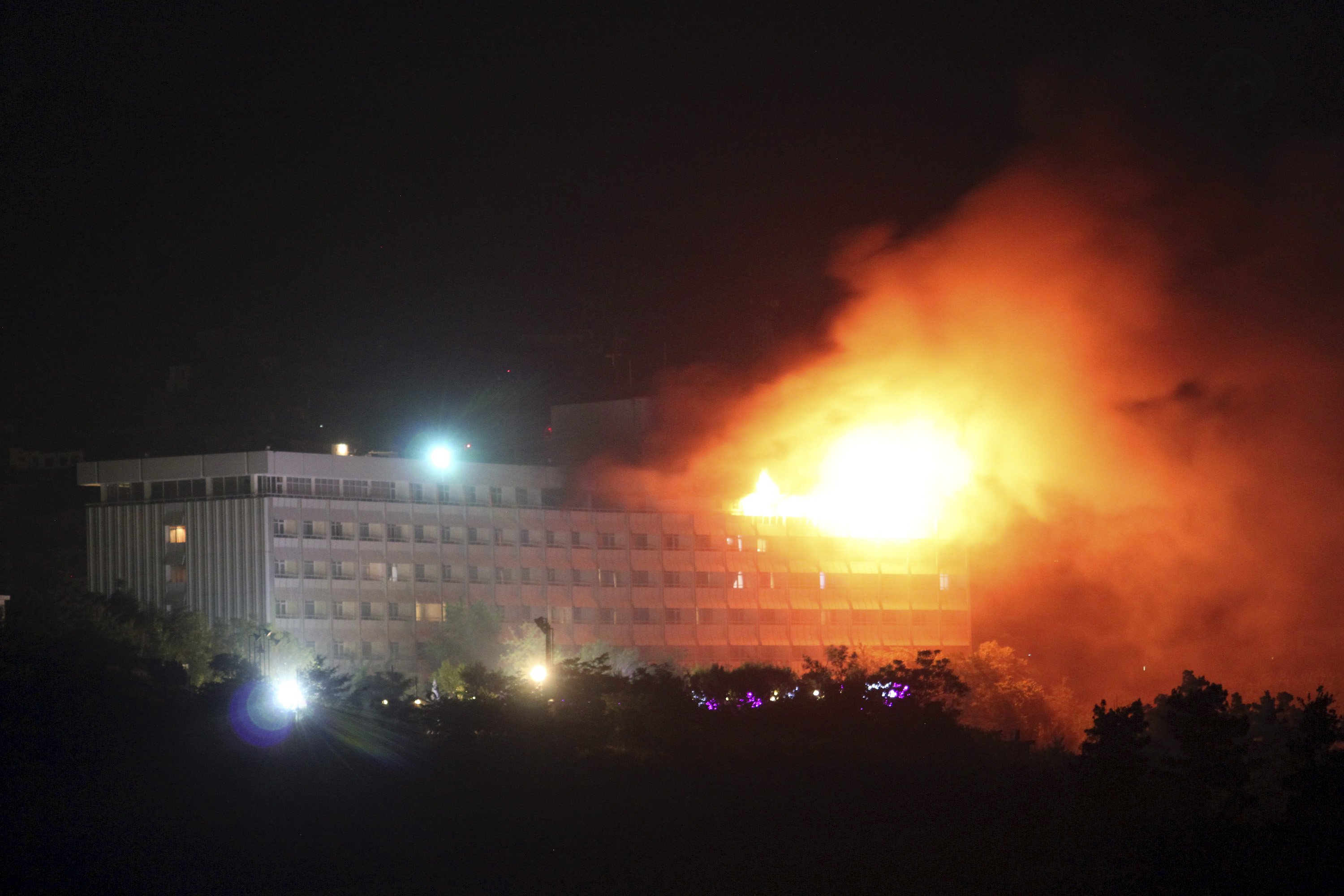
Smoke and flames rise from the Intercontinental hotel during a battle between NATO-led forces and suicide bombers in Kabul June 29, 2011. (Photo: Reuters)
Tuesday’s deadly attack on the Intercontinental Hotel in Kabul was a painful reminder that the U.S. drawdown from Afghanistan will not occur under conditions of Washington’s choosing. The Obama Administration strategy has been to escalate its offensive against the Afghan insurgents, particularly targeting their leaders, in order to make them more amenable to accepting Western terms for the political solution that remains the key ingredient of any withdrawal plan. (Few in Afghanistan seriously imagines that the Afghan security forces will be able to hold the line on the basis of the current distribution of political power when the U.S. completes its withdrawal in 2014 — changing that distribution of power will be a precondition for future stability.) But the Taliban’s strike on one of the most secure sanctuaries in the capital sent a high-visibility message that the insurgents won’t accept Western terms for peace, and that they continue to believe they can impose their own.
Of course, 9/11 and the al-Qaeda decade ought to have cautioned us against overestimating an adversary’s strength on the basis of one or two headline-grabbing mass-casualty attacks — the spectacular terror strike can provide an enemy with an illusion of formidability far in excess of his actual strength on the ground. But it would also be a mistake to see Tuesday’s attack as some sort of desperate ploy to distract attention from a declining position on the ground. The raid, timed to coincide with a conference on transferring security responsibility from NATO to Afghan forces in seven provinces (including Kabul), is but the latest in a steady uptick of attacks across the country. And as Aryn pointed out yesterday, the large-scale NATO counterinsurgency operations in the south have coincided with the expansion of Taliban control of much of central Afghanistan’s provinces that abut Kabul. Even after the surge implemented by the Obama Administration, which has reached a peak level of U.S. troops that will begin to decline next month, current Western force levels are not enough to pacify the country.
It was notable that President Obama’s drawdown announcement excluded the traditional qualifier of “conditions on the ground”, because winding up the Afghanistan mission is now motivated less by the political and security situation in that country than by the economic situation at home. Afghanistan’s security situation remains perilous, and the Karzai government — ostensibly the centerpiece of a strategy of handing over control to Afghans themselves — is facing a mounting political crisis in the form of challenges from its own legislature, and from some of the former warlords that helped bring it to power. The Taliban, for its part, is well aware of the limits in time and scale of the U.S. commitment, believing those factors strengthen the insurgents’ hand in shaping a political settlement.
It’s been reported that there is considerable debate within the Taliban leadership over the question of negotiations, with some senior figures keen to end the war quickly — but some of the younger commanders who have replaced those killed by the U.S. forces adopting more hard-line positions.
There’s also likely to be growing pressure from Pakistan, and insurgent groups it backs, to ensure that any deal is shaped to Islamabad’s interests, particularly in minimizing the influence of the India-aligned Northern Alliance that constitutes the backbone of the present regime. Some analysts saw Tuesday’s Kabul attack as being the work of a network that Afghan intelligence officials have previously alleged is linked with Pakistan’s Inter-Services Intelligence Agency. If so, that would be another reminder that while talks with the Taliban remain a key ingredient of any negotiated solution, a second indispensable component of such a solution will be talks between the U.S., Pakistan, Iran, India, Russia and other regional stakeholders. Because as long as their own national interests fuel an ongoing “great game” for proxy influence in Afghanistan, peace and stability remain unlikely.