


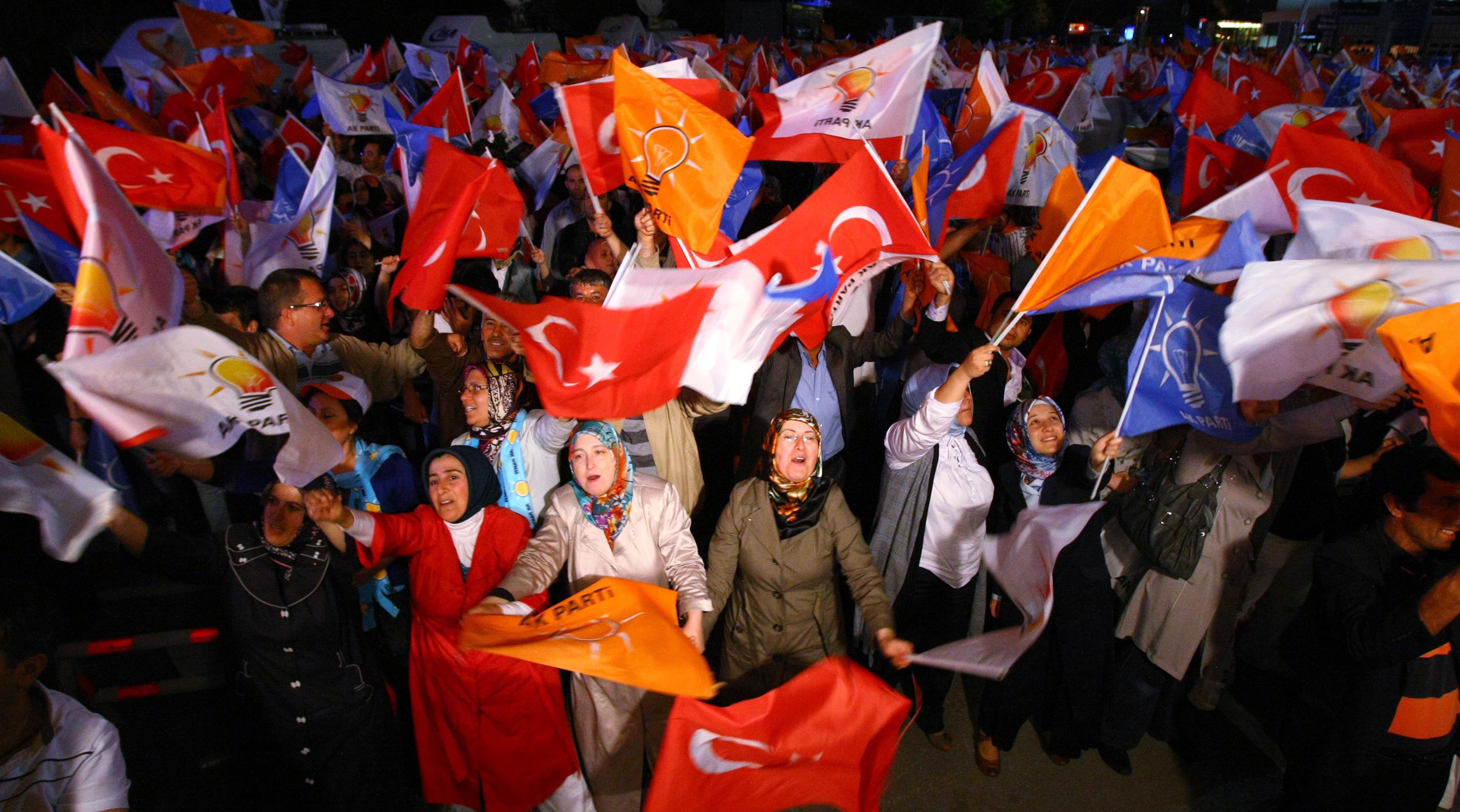
Supporters of Turkey's ruling party the Justice and Development Party (AKP) celebrate with party flags after the first results of the parliamentary election in front of party headquarters in Ankara on June 12, 2011. (Photo: Adem Altan / AFP / Getty Images)
Everybody wants a piece of Turkey. On my sweep through Egypt and Tunisia, virtually everyone I met invoked the nation that bestrides the Bosphorus as one they’d like their own country to emulate. The Turks had just had a general election, and Arabs had watched it unfold on Al Jazeera and other TV channels. The vote was clean, mostly uncontroversial, and peaceful. There was none of the violence that attends elections (real and rigged) in the Arab world. Journalists covering it marveled also at Turkey’s economic successes, as well as its growing cultural and political influence in the Middle East.
So it’s totally understandable that Egyptians and Tunisians should think to themselves, “Hey, I want all that for my country.”
But when they see Turkey, Arab liberals and Islamists see two very different countries. Liberals see a modern, powerful state where the military and the constitution guarantee a secular polity. Islamists see a modern, powerful state that is coming to terms with its Muslim identity and is run by a political party that’s unabashedly Islamic.
The debate is not theoretical. Both countries are preparing for elections this fall that will lead to the rewriting of their constitutions. Political and religious figures are already locking horns over who should do the rewriting, when and how. Many liberals favor constitutional reform now, elections later—not least because they worry that the Islamists will win big in the vote and dictate the reforms. Islamists (and some liberals) argue that reforms can only be legitimate when they are conducted by the peoples’ elected representatives.
Whenever the process begins, the people charged with remaking the Egyptian and Tunisian constitutions will look very closely at the Turkish example. Chances are the Islamists will aspire to Recep Tayyip Erdogan’s Turkey, whereas the liberals will favor Kemal Ataturk’s Turkey.
Essam Erian, a prominent leader of the Muslim Brotherhood, says liberals who fear his Islamist group’s clout should look to Turkey and find reassurance. “The elections there show that the AP Party cannot [re-make] the constitution alone,” he says. “The same will happen here. In Tunis, Abdelhamid Jlassi, leader of the Ennahda Party, a powerful Islamist group, is an admirer of Erdogan: “He has shown there is no contradiction between Islam and modernity.”
Ahmed Maher, one of the stalwarts of the Tahrir Square revolution and co-founder of the April 6 Youth Movement, says Egypt’s Islamists have been “studying the AK Party very closely.” But he worries that some may only “use the skin” of Erdogan’s party to hide a more extreme agenda. And Bassem Bouguerra, a prominent Tunisian blogger-activist, is less than impressed by the AK Party. “I’m not a big fan of the things I see in Turkey,” he says. The party’s election campaign, with its single-minded focus on the cult of Erdogan, reminded him too much of life under Tunisia’s former dictator, Zein El Abidine Ben Ali. “We don’t want that again,” he says.
Many liberals say they would like their new constitutions to empower the military and judiciary to serve as bulwarks against Islamist influence, just as Ataturk did in Turkey. But Mohamed Rifaah al-Tahtawy, a former diplomat who was spokesman for Cairo’s Al Azhar, the country’s highest religious authority, says that’s a short-sighted view, and undermines the democracy young Egyptians and Tunisians fought for. “That would be giving these institutions power to check the popular vote,” he says.
Expect the debate to grow more intense as elections approach.