


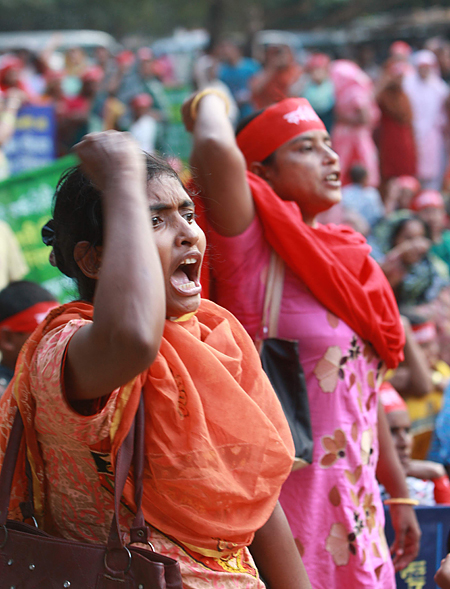
Members of Bangladesh Kormojibi Nari, or Bangladesh Working Women, shout slogans during a rally to mark International Day for the Elimination of Violence against Women in Dhaka, Bangladesh, Thursday, November 25, 2010. (Photo: Pavel Rahman / AP)
Sometimes, the law isn’t enough. It certainly wasn’t enough for Hena Akhter, the Bangladeshi girl whipped to death in January. After surviving rape, Hena, 14, was labelled an adulteress and sentenced, by local elders and clerics, to 10o lashes. “She couldn’t speak or eat afterwards, and she was bleeding through her nose, ears and mouth,” her mother told AFP. She died days later. Since then, at least three young women have reportedly killed themselves after being subjected to similarly brutal — and illegal — public punishment. They, like Hena, were beyond the reach of the law.
None of this should have happened. One year ago, Bangladesh’s Supreme Court ordered a crackdown on extra-judicial violence against women. Although the country’s law technically protects women’s rights, local councils regularly flout the rules. They issue de-facto ‘fatwas,’ religious opinions that are supposed to be issued by Islamic scholars, and order punishments that can range from public lashing, to forcing women to blacken their face or cut their hair. Ain-o-Salish Kendra, a local NGO, has documented hundreds of cases over the last ten years. They, and other groups, say the government isn’t doing enough to protect women from violence.
Of course, it’s not just Bangladesh. A report issued last week by UN Women finds that despite welcome advances, women the world over face a real and persistent ‘justice gap.’ The study notes, for instance, that 139 constitutions guarantee gender equality, 117 have equal pay laws and 125 outlaw domestic violence. And yet, equality is elusive, the pay gap endures and violence against women persists. “Promising equality, of course, is not the same as delivering it on the ground,” wrote the agency’s head, Michelle Bachelet, in an op-ed for the Huffington Post. “There sadly remains an immense gap between these welcome legal guarantees and everyday life for women.”
Which brings us back to Bangladesh. To mark the anniversary of the Supreme Court order, some of the country’s most respected NGOs are asking the government to speak out against the use of ‘fatwas’ to justify violence and humiliation. They’re calling for a massive public education campaign in schools, colleges and madrasas, as well as more support — legal, financial and emotional — for those affected. Getting more women involved in traditional dispute resolution might also help. As the UN study shows (see, for instance, the case study on Burundi), female participation in customary justice can and has improved the status of women. Let’s hope Bangladesh follows suit.
VIDEO: Bangladesh is creating new land for climate refugees.
Emily Rauhala is a writer-reporter at TIME. Find her on Twitter at @emilyrauhala. You can also continue the discussion on TIME’s Facebook page and on Twitter at @TIME.