


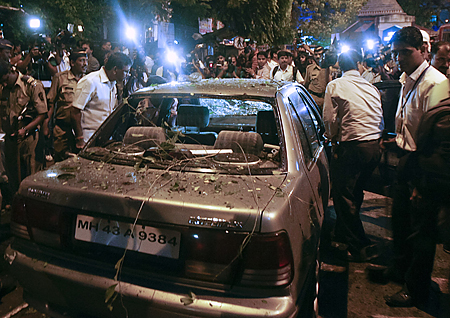
Plain clothed police surround a vehicle which was damaged at the site of an explosion in the Dadar area of Mumbai July 13, 2011. (Photo: Reuters)
Mumbai was hit by three serial blasts in heavily populated areas during rush hour on Wednesday night. Confirmed details are scarce, but local television channels are reporting as many as 21 people killed and dozens, perhaps over 100, injured. Police so far have not made any clear announcements, and India’s Home Ministry has confirmed only the obvious: that the coordinated, serial bomb blast was a terrorist attack. There is no word yet on who might be responsible or whether the blasts bear the imprint of local or foreign sources.
India’s Home Secretary, R.K. Singh, spoke briefly to CNN-IBN, confirming two dead and perhaps 100 injured. He said one of the bombs was planted inside a car, the other on a motorcycle. Other unconfirmed reports said one of the bombs was planted on top of an electric meter. Singh said the event was a terrorist attack, but that’s a loosely defined term in India, encompassing everything from the Mumbai underworld to the as-yet-undefined, unorganized group called Indian Mujahideen to the much more organized and deadly Lashkar-e-Taiba.
On its face, the incident looks more like the serial blasts that hit Mumbai in 2006 and 1993 than the infamous three-day-long terrorist attacks of 2008. As in those earlier incidents, the bombs were planted and detonated anonymously — one television channel showed images of a forensic investigator picking through the remains of a tiffin box, the ubiquitous stainless-steel lunch container — that might have been used as a container for an IED. In 2006 the explosives were packed into pressure containers. The 1993 attack was linked to Dawood Ibrahim, the supposed kingpin of the coastal metropolis’ murky underworld, who may have ties to local Islamist militants and groups in Pakistan. Indian authorities pinned the 2006 bombings on local Islamists and the Pakistan-based Lashkar-e-Taiba. The 2008 attacks, on the other hand, were conducted by a team of heavily armed commandos on a suicide mission, a very different kind of assault requiring a much greater level of training, planning and logistical sophistication.
Another difference is the targets of Wednesday’s explosion: Zaveri Bazaar, a bustling jewelry market that was also the site of one of the 1993 blasts; Kabutar Khana (the Pigeon House), a neighborhood in the Dadar West area, which was also targeted in 1993; and a khau galli (food lane), a spot where commuters stop to eat, near the Opera House in South Mumbai. What ties these spots together is that they are all packed with people, ordinary Mumbaikars, and the first two spots at least are associated with particular communities: Gujarati merchants and the Marathi-speaking majority. Again, that is similar to the 2006 and 1993 blasts but different from the 2008 attack, which singled out places popular with foreign tourists and the wealthy elite.
The other big difference in these attacks is the speed with which the national authorities have moved into action. Singh confirmed that two teams, one from the National Investigation Agency (NIA) and one from the National Security Guard (NSG), have already moved onto the scene to secure evidence and begin the process of finding suspects. So far, no group has publicly claimed responsibility. The NIA was set up in response to the dismal performance of India’s security agencies before the 2008 attack, and it has proved its necessity. The NSG, meanwhile, supplied the commandos who arrived belatedly but did eventually put down the Mumbai rampage. This may not be a repeat of Mumbai 2008, but it’s clear that some of those lessons have been learned.