America or China? The World Has Already Decided Who’s No. 1

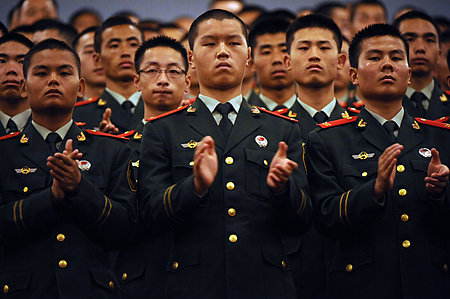
Members of the Chinese military applaud after Chinese President Hu Jintao inside the Great Hall of the People in Beijing as part of celebrations for the Chinese Communist Party's 90th anniversary on July 1, 2011. Photo: Peter Parks - AFP - Getty Images)

Who’s the world’s new superpower? China, according to a poll by Pew Research Center’s Global Attitudes Project, which surveyed more than 27,000 people globally:

In 15 of 22 nations, the balance of opinion is that China either will replace or already has replaced the U.S. as the world’s leading superpower…This especially is the case in Western Europe, where at least six-in-ten in France, Spain, Britain and Germany see China overtaking the U.S. This view has increased substantially over the past two years, including by 10 or more percentage points in Spain, France, Pakistan, Britain, Jordan, Israel, Poland and Germany. Among Americans, the percentage who say that China will eventually overshadow the U.S. has increased from 33% in 2009 to 46% in 2011.

But not everyone’s buying the China No. 1 narrative, particularly the Chinese themselves:

Majorities or pluralities in Eastern Europe, Asia and Latin America still name the U.S. as the world’s dominant economic power. Notably, by an almost 2-to-1 margin, the Chinese still believe the U.S. is the world’s leading economic power…Global opinion is consistently negative when it comes to the prospect of China equaling the U.S. militarily. Besides the Chinese themselves, only a handful of publics see an upside to China matching the U.S. in military power.

Related Topics: Global Attitudes Project, Pew Research Center, Business, China
  • Latest on Global Spin

    Pablo Martinez Monsivais / AP

    Obama’s Afghanistan Problem: Neither Karzai Nor the Taliban Like the ‘Reconciliation’ Script

    President Barack Obama huddled with President Hamid Karzai in Chicago on Sunday, urging Afghanistan’s leader to accelerate negotiations with the Taliban over a political solution to the longest war in America’s history. But the prospect for Karzai negotiating successfully with the insurgents is clouded by a question raised by Josef Stalin, on the eve of World War II, in response to the suggestion that he offer concessions to the Pope: “How many divisions does he have?” The Taliban now ask the same question about Karzai. And should the Afghan leader also ask himself the question, he might reach a similarly dispiriting conclusion. Karzai’s independent power base is minimal, as is his ability to influence the outcome of his country’s civil war absent direct U.S. involvement. And that gives neither Karzai nor the Taliban much incentive to cut a deal with the other.

    JOSEPH EID/AFP/GettyImages

    Must-Reads from Around the World, May 21, 2012

    Spillover - Lebanon’s Daily Star reports on escalating violence inside the country after soldiers shot dead a prominent anti-Bashar al-Assad Muslim preacher Sunday. “The gravity of the incident… prompted leaders on both sides of the political divide to call for calm and restraint to prevent the country from sliding into sectarian strife as a result of a spillover of the 15-month-old uprising in neighboring Syria,” it says.

    UPPA / ZUMAPRESS

    A Royal Party: Britain Celebrates 60 Years of Queen Elizabeth II

    From parades to concerts, and even tea with commoners, 86 year-old Queen Elizabeth II is traversing the United Kingdom to commemorate her Diamond Jubilee.

blog comments powered by Disqus