


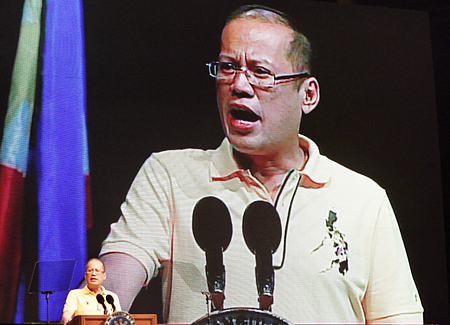
President Benigno Aquino III delivers his message before a big crowd of students and government officials during the celebration for his first year in office, June 30, 2011 in suburban Pasig City east of Manila, Philippines. (Photo: Pat Roque - AP)
Philippine President Benigno “Noynoy” Aquino III crested into office last year on a mandate for change. A scion of the country’s most famous political family, he benefited from not only the aura of his parents’ legacy, but his own reputation of earnestness, honesty and incorruptibility. His approval ratings remain high after more than 12 months in power, but his record is mixed, not least after Human Rights Watch, the New York-based global rights NGO, issued a damning report yesterday documenting at least seven extrajudicial killings and three enforced disappearances of leftist activists that have taken place under Aquino’s watch. The report reads:
During his campaign for president, Benigno Aquino III pledged to end serious violations of human rights in the Philippines. Yet since taking office on June 30, 2010, the Philippine military continues to be implicated in apparently politically-motivated extrajudicial killings—deliberate unlawful killings by state security forces—and enforced disappearances. These abuses persist in part because of the Philippine police’s failure to conduct thorough and impartial investigations, particularly when evidence points to military involvement.
The culture of impunity and rank injustice that seemed to permeate some of the country’s state institutions were things Aquino vowed to stamp out, at least when he and I met just weeks before his landslide 2010 election victory.
Back then, I reported:
The rot in the Philippine system was perfectly illustrated last November, when gunmen in the service of the Ampatuans, a powerful ruling family in the Mindanao province of Maguindanao, ambushed the entourage of a rival politician, killing 57 people, including over two dozen journalists. The grisly massacre — some bodies were grotesquely mutilated and defiled — shocked the country and made global headlines. But while [then President Gloria] Arroyo has arrested leading Ampatuans and called for a ban on guns ahead of the polls, her opponents cite the clan’s long-standing ties to her administration, which, they say, doled out generous state funding from Manila in exchange for support during local elections. “The incident dramatized the way feudal politics play out in the Philippines,” says Marites Vitug, editor of Newsbreak, a respected Manila newsweekly.
What enraged many observers, beyond just the prevalence of naked warlordism in some of the poorer reaches of the country, was the audacity of the attack. It’s a symptom, say Vitug and others, of a culture of impunity that has cemented itself in the Philippines over the decades and become exacerbated under the present government. A 2009 U.S. State Department report chronicled widespread extrajudicial killings and the disappearances of human-rights activists and leftist journalists, as well as the mistreatment of Muslims in the country’s insurgency-ravaged south. It called corruption in the Philippines “endemic.”
Aquino has made slow progress forging a dent in that ‘endemic’ corruption, recruiting a cabinet of ministers many deem to be as professional and efficient as they come. But court cases against known corrupt officials of the previous Arroyo administration have been only sparsely lodged. Human Rights Watch adds to the chorus of criticism, decrying how attacks on opponents, leftists or otherwise — like the grisly Ampatuan massacre — can still take place. “The brazen nature of some of these abuses, in broad daylight and in front of witnesses,” said one HRW spokesperson to Al-Jazeera, “shows how members of the military can kill and ‘disappear’ people with little regard for the consequences.” Aquino, who lost his own father to what most presume was a military hit squad, ought to want to dispel such impunity more than most.