


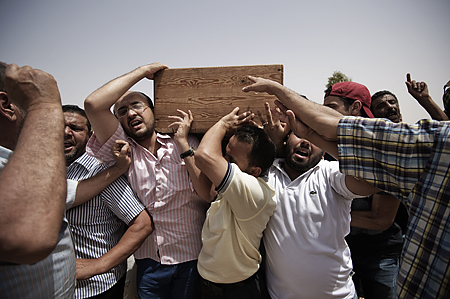
Relatives and fellow fighters mourn as they carry the coffin of one of 7 Libyan rebel fighters killed the day before during the battle for the control of the oil rich town of Brega at the main cemetery in the Libyan rebels stronghold city of Benghazi on July 20, 2011. (Photo: Gianluigi Guercia - AFP - Getty Images)
Washington insists that the U.S. officials who met with representatives of Colonel Muammar Gaddafi in Tunisia last week were not negotiating; they simply went to deliver one message: “Gaddafi must go.” There’s no reason to doubt that this demand was the center-piece of what the Americans told Gaddafi’s emissaries, since Obama Administration concurs with all the NATO powers — and even those skeptical of the Western alliance’s war effort, such as Russia and the African Union — that the key to a political solution to the conflict is for the self-styled “Brother Leader” to relinquish power. But that message has been delivered repeatedly through the metaphorical megaphone of the media throughout the five-month civil war. Presumably the reason it was communicated discreetly by diplomats behind closed doors last weekend is that it was accompanied by some ideas on just how Gaddafi might “go”, and what would follow if he does.
While the Benghazi-based rebel leadership of the Transitional National Council — recognized last weekend by the U.S. and others as the legitimate government of Libya, even though it’s far from clear that it actually commands all of the rebel forces in the field — has long insisted that Gaddafi and his son Saif al-Islam leave the country to face international justice at the Hague, key NATO powers involved in the campaign appear to be fashioning a compromise. France’s foreign minister Alain Juppe indicated Wednesday that a deal could be worked out that would allow Gaddafi to remain in the country if he agreed to cede power.
That option would change the current equation in which Gaddafi’s fate if he surrenders is a jail cell in the Netherlands — a prospect that stiffens his resistance. It also addresses the fact that the regime still maintains a considerable support base of Libyans willing to fight for Gaddafi. And rebel reservations are unlikely to be sustained if NATO presses for a compromise, because the Western alliance’s combat involvement is the key element of the rebel war effort. (Western fighters flying close air-support combat missions have this week allowed the rebels to press the offensive in the eastern oil port of Brega.)
While the limits of NATO’s resources, which are unlikely to support a combat role beyond the end of summer, create the urgency for a political solution, Western powers also recognize a virtue in that necessity because of what they learned in Iraq about the Herculean challenges of rebuilding a country more likely to plunge into civil war than to sustain an orderly transition to democracy.
Right now, of course, Gaddafi is fighting on, and making diplomatic probes designed to detect divisions among his adversaries. Even if they accept the inevitability of his relinquishing his current leadership role, those around Gaddafi — particularly his son Saif al-Islam — clearly envisage themselves negotiating a new dispensation as equal partners with the rebel leadership. The rebels balk at that idea, and NATO, dispensing with the fig-leaf of its “protect civilians” international mandate, is providing air support for a rebel offensive aimed at capturing new territory and persuading the regime to settle for less than it currently demands. But the basic architecture of the strategic stalemate remains largely unchanged despite recent rebel tactical gains on the ground. That’s why, both on the battlefield, and in the discreet chambers of diplomacy, the contest is now one to define the parameters of the political solution that has become the all-but-inevitable conclusion to the current phase of the Libyan conflict.