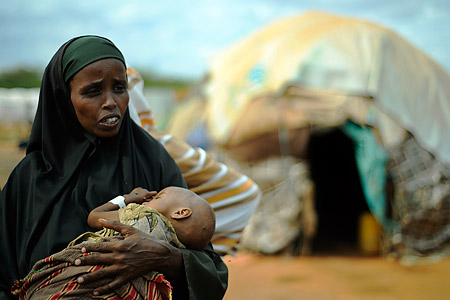
Famine in Somalia: When Does the World Decide to Use the ‘F’ Word?


The word ‘famine’ may be a familiar one, but it is not thrown around lightly by the people who decide when there is one. The fact that most of us today probably associate the term with the 1984 crisis in Ethiopia is testament to its exceedingly careful dispensation; to use it too often would dilute its power to command the attention of the press and governments around the world. Famines don’t happen overnight, but when the United Nations declares one, those governments are expected to pay attention – and help pay to get the situation under control.

On Wednesday, the U.N. declared two regions in southern Somalia as being in the midst of a famine. It’s the first time the word has been used in that country in nearly 20 years and the first time it’s been employed anywhere in the 21st century. The famine comes after months of the worst drought in East Africa in more than half a century, and is affecting about 3.5 million people around the country, most of whom are in the south. Over 165,000 Somalis have already fled to Kenya to get access to food and water; every day, over 1000 refugees are arriving in Dadaab, the world’s largest refugee camp, pushing conditions there to the limit.

Read the rest of the post on Ecocentric.
Related Topics: drought, famine, refugees, somalia, Africa, Human rights, Humanitarian aid, Infrastructure, U.N.
  • Latest on Global Spin

    Benjamin Hiller/Corbis

    Must-Reads from Around the World, May 22, 2012

    Summit Struggle - Ahead of Wednesday’s crunch E.U. summit, Der Spiegel reports that new French President François Hollande will pressure German Chancellor Angela Merkel to agree to euro bonds, which she has so far strictly opposed. “Italy and Britain are expected to back Hollande in a further sign that Merkel is increasingly isolated in Europe with her austerity plan for saving the euro,” the German news magazine predicts.

    Yin Dongxun/Xinhua/ZUMAPRESS.com

    Jerusalem Day in the Old City: The Conflict Marches On

    Sunday was Jerusalem Day in Israel, a holiday once again observed by thousands of young Jews who chanted as they marched through Arab neighborhoods conquered in the 1967 Six Day War. The tension is always highest in the narrow passages of the largely Palestinian Old City. So much so that the city’s police this year tried to route the column of youths — most singing patriotic and religious songs, a few chanting “Death to the Arabs” — away from the Arab Quarter. But in the end, the police proved powerless against tradition, and the original route was restored. On Jerusalem Day, marching through the Arab Quarter is the whole point.

    Pablo Martinez Monsivais / AP

    Obama’s Afghanistan Problem: Neither Karzai Nor the Taliban Like the ‘Reconciliation’ Script

    President Barack Obama huddled with President Hamid Karzai in Chicago on Sunday, urging Afghanistan’s leader to accelerate negotiations with the Taliban over a political solution to the longest war in America’s history. But the prospect for Karzai negotiating successfully with the insurgents is clouded by a question raised by Josef Stalin, on the eve of World War II, in response to the suggestion that he offer concessions to the Pope: “How many divisions does he have?” The Taliban now ask the same question about Karzai. And should the Afghan leader also ask himself the question, he might reach a similarly dispiriting conclusion. Karzai’s independent power base is minimal, as is his ability to influence the outcome of his country’s civil war absent direct U.S. involvement. And that gives neither Karzai nor the Taliban much incentive to cut a deal with the other.

blog comments powered by Disqus