


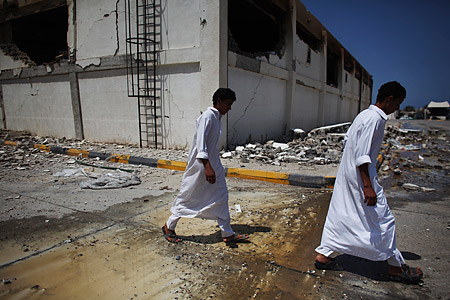
In a photo taken on a government-organized tour, Libyan boys walk past a food warehouse in the town of Zlitan that was struck during a NATO airstrike, July 25, 2011 (Photo: Tara Todras-Whitehill / AP)
It’s getting harder and harder to believe there’ll eventually be a resolution to Libya’s civil war that will allow anyone to claim Muammar Gaddafi lost to rebel forces—or was humbled by members of the NATO-led coalition waging air strikes against him. Indeed, it’s becoming increasingly clear as the weeks rush by that battle-weary European partners in the intervention force are keener to find ways of ending the conflict and pull forces back home than they are to obtain their initial objectives of seeing Gaddafi deposed and forced abroad. The upshot is the sound of diplomatic throats being cleared ever louder to prepare public opinion for the now-probable scenario of the operation ending without Gaddafi having budged much.
As Tony’s July 20 post noted, U.S. officials came away from recent meetings in Tunisia with Gaddafi representatives repeating demands that the colonel “must go” as a part of any resolution to the conflict. Yet even then it was becoming evident that what “go” ultimately entails may not meet the definition rebels have long advanced: of Gaddafi being forcefully driven from power, arrested, and handed over to the U.N. tribunal wanting to try him for crimes against humanity. On July 20, French Foreign Minister Alain Juppé told French TV channel LCI that “one of the hypotheses that’s envisioned is, indeed, that (Gaddafi) stays in Libya on the condition he very clearly leaves Libyan political life”. That considerably watered down position on the criteria to end the conflict was then repeated on July 25 by British Foreign Secretary William Hague. While remaining adamant that “Gaddafi must leave power”, Hague left the Libyan leader’s fate beyond that open to question.
“Obviously him leaving Libya itself would be the best way of showing the Libyan people that they no longer have to live in fear of Gaddafi,” Hague said Monday, prior to his meeting with Juppé in London. “But as I have said all along, this is ultimately a question for Libyans to determine.”
True—sort of—though that shifted position rather glosses over a couple very significant considerations undermining hopes that the initial goal of driving Gaddafi into exile—or prison—will ever be achieved. First off, the mere fact Western allies—and especially the UK and France, who were the most gung-ho advocates for launching the air intervention—have now clearly loosened their conditions for bringing the war to an end is the direct consequence of Gaddafi and his army having withstood the combined power of NATO strikes and rebel offensives far better and longer than expected. As a result, figuring out a conflict-ending, face-saving scenario with Gaddafi still factored in has become obligatory for American and European leaders aching to find a ways of getting the costly campaign over with.
Second, the fact that those Western powers are now openly considering an outcome with Gaddafi still in Libya—though at least nominally out of power—clashes frontally with rebels’ rejection of the scenario as a non-starter tends to support claims Gaddafi’s backers have long made: to wit, that the insurgents exist as a military and political force due exclusively to Western backing, and as such will ultimately accept the conditions and do the bidding of foreign capitals providing them funds, arms, and air support. Gaddafi managing to remain in Libya, therefore, would not only allow him a safe and secure place from which to meddle with the country’s new government, but also give his anti-imperialist, anti-Western propaganda ranting a degree of credibility it never enjoyed before.
To be fair to Western allies, there aren’t too many other realistic options to accepting Gaddafi remaining hunkered down somewhere in Libya’s future if they ever want to extricate themselves from the military operation they bounded into four months ago. Despite that, their pragmatism won’t protect them from accusations on all sides that their war costs lots of money, many lives, and much credibility in return for what in the end may not be a whole lot.