


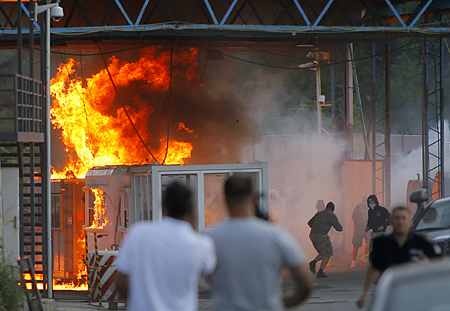
A border crossing between Serbia and Kosovo is set ablaze by hundreds of Serb youths, in Jarinje, on July 27, 2011. (Photo: AFP / Getty Images)
Throughout NATO’s war in Libya, the operation there has been compared with the one in Kosovo in 1999, in which 72 days of bombing Serbia forced the withdrawal of government forces from the province, where they’d been engaged in a campaign of “ethnic cleansing” against the ethnic-Albanian majority. But while Libya has dragged on twice as long and isn’t over yet, a week of violent clashes in northern Kosovo involving the ethnic-Albanian Kosovar government, its ethnic Serb minority, and some of the 10,000 NATO troops still deployed there may be a sign that hotheads on both sides sense an opportunity to rewrite the outcome of the 1999 war.
Violent clashes on Monday and Tuesday left one Kosovar policeman dead and a border post burned to the ground while NATO forces came under fire on Wednesday from suspected Serb nationalists on Wednesday. The fighting has been sparked by a dispute whose roots lie in the contested terms on which the war ended: NATO took charge of the Serbian province of some 1.7 million people, turning into a European protectorate and de facto state that eventually declared independence in 2008 — although the opposition of Serbia, Russia, China and some European countries has prevented it from being recognized as an independent state by the U.N. or E.U. While 95% of the population is ethnic-Albanian, a Serb minority totaling some 60,000 remains in an embattled enclave that stretches from the divided town of Mitrovice north to the Serb border. Inside that enclave, Kosovo’s independence is also not recognized, and the Serbs living there continue to receive financial aid and social services from Belgrade.
The battle for the border posts occurred amid a politically inspired trade dispute between Kosovo and Serbia. Kosovar police tried on Monday to take over the crossings, which have been run since 2008 by an EU mission, in order to enforce a ban on imports from Serbia. That measure had been enacted last week in retaliation for Serbia’s refusal to accept imports from Kosovo on the grounds that it can’t accept customs paperwork from the “Republic of Kosovo”, an entity it doesn’t recognize. While the Kosovar authorities say they’re exercising a sovereign right to control the territory’s border crossings, the local Serb community vows to stop what they see as an effort to cut their links to Serbia. And U.S. and European officials condemned the Kosovar side for a provocative action undertaken without consultation, but called on all sides to restore calm and negotiate a compromise.
While the Serbs and the rest of NATO’s rivals never really accepted the breakaway of Kosovo from Serbia, the Kosovar Albanians chafed at the persistence of a Serb enclave denying Kosovo’s independence within what it claimed as sovereign borders. But NATO’s dominance has enabled it, until now, to enforce its writ on both sides. Serbia’s moderate President Boris Tadic, who knows his goal of joining the EU depends on solving the Kosovo issue, condemned the violence, making clear that Serbia has no appetite for war — but he also warned that any encouragement of Kosovar authorities to take control of the Serb enclave put peace at risk. Kosovo President Hashem Thaci seemed more inclined to talk tough, warning that the Serb enclave would never be allowed to return to Belgrade’s control.
The original Kosovo war was sparked by a very small number of ultra-nationalists in the Kosovo Liberation Army (on the State Department’s list of terrorist organization until that became impolitic since the war would obviously put it in power). The KLA, led by Thaci, engaged in a systematic campaign of attacks on local Serb officials, which eventually succeeded in provoking a spectacularly brutal Serbian retaliation, which in turn prompted the NATO intervention.
Some Western diplomats in Kosovo see the sudden move to seize the border posts as nationalist grandstanding for votes with an election coming up. But there may be elements in among the Serbs in northern Kosovo quite willing to take the bait and roll the dice. After all, NATO is overstretched and exhausted by its commitments in Afghanistan and Libya, and will have little appetite for any expansion of its role in the Balkans. Some of those still inclined to refight the wars of the ’90s in the hope of changing the outcome may be sensing an opportunity.