


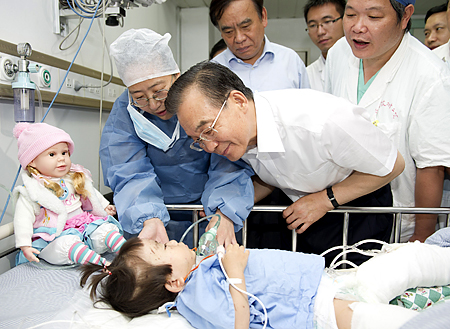
Chinese Premier Wen Jiabao (C) visits Xiang Weiyi, a two-and-half-year-old toddler who was still hospitalized in ICU for injuries in the weekend high-speed train crash in Wenzhou City, east China's Zhejiang Province, July 28, 2011. (Photo: Huang Jingwen / XinHua / Corbis)
When things go truly wrong in China, Chinese Premier Wen Jiabao is bound to make an appearance. Grandpa Wen, as the 69-year-old leader is affectionately known, is China’s Consoler in Chief, a soothing presence in the face of disaster. In 2008 he headed to the airport to board a flight to Sichuan 90 minutes after a massive earthquake struck there, killings tens of thousands. On Thursday, five days after a train crash near the eastern city of Wenzhou killed at least 39 people and injured nearly 200 more, Wen visited the area, where he comforted victims, pledged an investigation and expressed his confidence in the future of China’s rail system.
He blamed the delay in his visit on an unspecified illness. “I am ill, having spent 11 days in bed, but I managed to come today only after my doctor reluctantly allowed me to check out of hospital. This is why I didn’t come here sooner,” Wen said, according to the official Xinhua news service. His statement was surprising given the secrecy with which the Chinese government guards information about the health of top leaders. More troubling for the Chinese government’s post-crash public-relations efforts was the way Wen’s statement was quickly called into question.
As McClatchy Newspapers’ Tom Lasseter pointed out in a blog post, Xinhua ran a story, complete with photos, of Wen meeting a Japanese trade delegation on Sunday, July 24, one day after the crash and in the middle of the period that Wen said he was bedridden. It appears that Xinhua’s English-language report misquoted Wen, and the Premier in fact said nothing about being hospitalized, only that his doctor hadn’t allowed him to travel. Still, on sites like the Chinese microblog service Sina Weibo, some posters raised questions about how Wen’s meeting with the Japanese delegation squared in Beijing with his statement that he had been bedridden for 11 days. Of course, a meeting in the capital is far less taxing than tromping across a disaster site, and Wen could have handled his responsibilities in Beijing despite being too sick to travel. Still, a timelier release about his conditions could have avoided this round of questions. In this respect the government seems a victim of its own secrecy.
The days following Saturday’s collision have seen rising public doubts and anger over the official explanations of the disaster. Wen’s visit seemed designed to send the message the leadership in Beijing heard the concerns and planned to get to the bottom of what went wrong. He promised a top-level investigation into the crash that would “stand the test of history.” His own story might not fare so well.