In Indonesia, Murders by a ‘Lynch Mob’ Go Lightly Punished

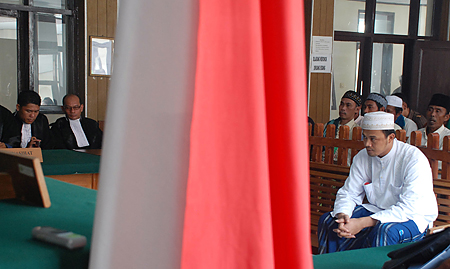
Idris (R) An Indonesian Muslim accused attacking Ahmadiyah sits waiting for his verdict at the court room in Serang, Indonesia's Banten province July 28, 2011. (Photo: Aulia Pratama / Reuters)

Less than six months after a hundreds-strong mob beat members of a minority sect with machetes, rocks and bamboo poles, killing three, the leaders of the barrage will walk free. The attack, which took place in a remote village in Banten province, was captured on video. Yesterday, at a heavily fortified courthouse  outside the capital, the twelve men convicted in the case received sentences of just three to six months. Dani bin Misra, a young man filmed smashing the skull of a limp, bloodied body, got three months for public incitement.  Both local and international observers have questioned the impartiality of the investigation, the trial and the sentences. But the government won’t back down.

On Friday, Indonesia’s minister of religious affairs, Suryadharma Ali, told TIME that he was “not in a position to judge the fairness of a court result,” but he believed the country’s judges were both willing and able to enforce the law.  He also defended a decree, issued in 2008, that prohibits members of Ahmadiyah  from practicing their faith in public or spreading their beliefs. Ahmadis believe their sect’s founder, a 19th century Indian named Mizra Ghulam Ahmad, was a prophet. Many Muslims, including the minister, consider this claim heretical. He said that although he supports freedom of religion, Ahmadis ought not use that freedom to “completely modify” Islam’s core beliefs.

Critics counter that the government’s stance, and the recent trial, privilege religious doctrine over basic rights, threatening the country’s proud tradition of pluralism. Human Rights Watch called it “a sad day” for Indonesian justice. The United States issued a statement saying it was disappointed by “the disproportionately light sentences.” It also called on Indonesia to “defend its tradition of tolerance for all religions.” The chairman of one of the country’s largest Muslim organizations, Muhammadiyah, also spoke out. “The punishment is too soft,” Din Syamsuddin told the Jakarta Post. “That hurts me.”  No doubt it hurts the country, too.

More:  Read about Indonesia’s religious revolution.

Emily Rauhala is a writer-reporter at TIME. Find her on Twitter at @emilyrauhala. You can also continue the discussion on TIME’s Facebook page and on Twitter at @TIME.

Related Topics: Ahmadi, Ahmadiyah, Cikeusik, Cikeusik Ahmadiyah, indonesia, religious minorities, religious violence, Suryadharma, violence, Asia, Islam
  • Latest on Global Spin

    Benjamin Hiller/Corbis

    Must-Reads from Around the World, May 22, 2012

    Summit Struggle - Ahead of Wednesday’s crunch E.U. summit, Der Spiegel reports that new French President François Hollande will pressure German Chancellor Angela Merkel to agree to euro bonds, which she has so far strictly opposed. “Italy and Britain are expected to back Hollande in a further sign that Merkel is increasingly isolated in Europe with her austerity plan for saving the euro,” the German news magazine predicts.

    Yin Dongxun/Xinhua/ZUMAPRESS.com

    Jerusalem Day in the Old City: The Conflict Marches On

    Sunday was Jerusalem Day in Israel, a holiday once again observed by thousands of young Jews who chanted as they marched through Arab neighborhoods conquered in the 1967 Six Day War. The tension is always highest in the narrow passages of the largely Palestinian Old City. So much so that the city’s police this year tried to route the column of youths — most singing patriotic and religious songs, a few chanting “Death to the Arabs” — away from the Arab Quarter. But in the end, the police proved powerless against tradition, and the original route was restored. On Jerusalem Day, marching through the Arab Quarter is the whole point.

    Pablo Martinez Monsivais / AP

    Obama’s Afghanistan Problem: Neither Karzai Nor the Taliban Like the ‘Reconciliation’ Script

    President Barack Obama huddled with President Hamid Karzai in Chicago on Sunday, urging Afghanistan’s leader to accelerate negotiations with the Taliban over a political solution to the longest war in America’s history. But the prospect for Karzai negotiating successfully with the insurgents is clouded by a question raised by Josef Stalin, on the eve of World War II, in response to the suggestion that he offer concessions to the Pope: “How many divisions does he have?” The Taliban now ask the same question about Karzai. And should the Afghan leader also ask himself the question, he might reach a similarly dispiriting conclusion. Karzai’s independent power base is minimal, as is his ability to influence the outcome of his country’s civil war absent direct U.S. involvement. And that gives neither Karzai nor the Taliban much incentive to cut a deal with the other.

blog comments powered by Disqus