


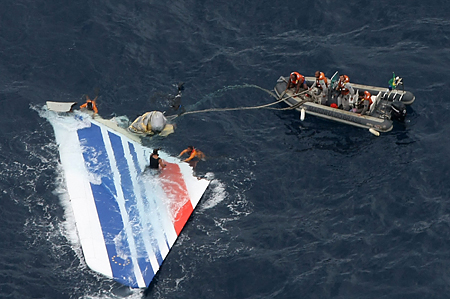
Brazilian Navy sailors pick up a piece of debris from Air France flight AF447 out of the Atlantic Ocean, about 745 miles (1,200 km) northeast of Recife, June 8, 2009. (Photo: Brazilian Air Force / Reuters)
Some of the mystery behind the tragedy may be solved, but that doesn’t mean fighting is over about who’s to blame for the 2009 crash of Air France flight 447 from Rio de Janeiro to Paris. New findings released Friday by French investigators indicated pilots of the craft were insufficiently trained for the emergency situation that wound up claiming 228 lives. The report also said crew repeatedly ignored system alerts that their Airbus A330 had gone into the disastrous stall—and failed to recognize the craft was in the halting position that caused it to plummet into the Atlantic. As a result, France’s Bureau of Investigations and Analyses (BEA) recommended new training procedures be initiated to prepare cockpit staff for such high altitude crises—even as Air France rejected suggestions its pilots were in any way to blame for the disaster.
The BEA’s study certainly isn’t the last word on the AF 447 crash, but it does provide official analysis of cockpit recorders found on the ocean floor in May—nearly two years after the plane went down in a stormy zone of turbulence June 1, 2009. Awaiting its complete investigation early next year, the BEA issued a preliminary finding Friday indicating trouble began a bit over two hours into the flight. Seeking to avert a zone of severe turbulence the plane had entered, co-pilots disengaged the autopilot and took manual flight control—a mode the BEA said the crew hadn’t been trained in. The situation became critical when speed sensors failed—probably due to freezing—and deprived pilots of accurate velocity readings necessary to calculate flying maneuvers. The result was a series of moves that reduced the plane’s speed and placed it in a nose-up position causing an aerodynamic stall. That led to the craft dropping some 38,000 feet into the sea in the space of nearly four minutes.
(SEE: Photos of the Air France flight’s recovered wreckage.)
The BEA’s report said pilots appear to have ignored repeated stall alerts, and never got around to warning cabin crew or passengers of an abnormal situation. That may have well been due to co-pilots having instead been focused on dealing with an increasingly urgent situation without all the information or experience it required. In addition to pilots not having undergone training for manual flight, the BEA also said they’d gotten no instruction on how to confront similar emergency situations at high altitudes. Such preparation however, is increasingly rare in an age of technically sophisticated aircraft with multiple back-up systems—one reason why the BEA suggests all French and European airlines launch mandatory programs to prepare pilots for such disastrous situations, however rare they may be.
Air France responded to the report with a communiqué noting the tragic nature of the crash, but stressing “nothing at this stage allows for the technical competence of the crew to be called into question”. The statement also said pilots “showed unfailing professional attitude, remaining committed to their task to the very end”, and paid “tribute to the courage and determination they showed in such extreme conditions”.
However genuinely held it is, that position also reflects the high financial and business stakes involved in determining who was ultimately responsible for the crash. It’s technical inquiry notwithstanding, that’s a decision on culpability the purely analytical BEA will leave to French prosecutors and courts to decide. Both Air France and A330 maker Airbus are being investigated by French legal authorities studying whether manslaughter charges might be merited in the crash. That inquiry arose in part from allegations by victims’ families that Airbus equipped its craft with external speed detectors that had previously been found defective. Air France has replaced those sensors on its A330s in the wake of flight 447’s crash, yet there have been allegations the airline had been advised to change them before hand. Both Airbus and Air France have denied negligence or willful use of defective equipment in the affair.
Thus far there has been little to suggest there’s anything to reproach Air France or Airbus for in the accident, or that either could have done anything to avoid the Rio to Paris crash. And while incomplete, the BEA’s report on Friday mostly stressed the apparent failure of pilots to identify the problem the plane was having, and take measures necessary to avoid the crash—primarily, thrusting the nose downwards and significantly increasing speed.
“There are many confusing aspects about this accident,” said BEA director Jean-Paul Troadec during a press conference. “Reactions by the pilots are among those”.
Perhaps, yet response to Friday’s report by representatives of victims’ families shows their suspicion of corporate fault remains high.
“Human error was cited as the cause of the crash very early on, which raised suspicions about the premature efforts to blame the pilots when so much technical information was lacking,” Robert Soulas, whose daughter died in the crash, told French TV news channel LCI. “Despite the contestable and condemnable assertion the pilots were at fault, there are still lots of questions and gray zones surrounding the technical aspect of the crash.”