


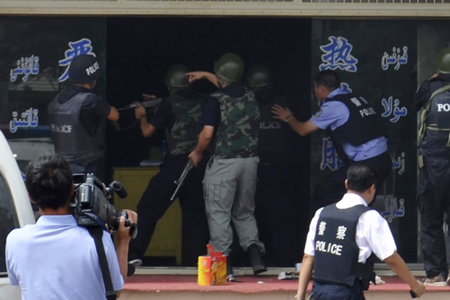
Armed policemen try to rescue hostages at a police station during a clash in Hotan, Xinjiang Uygur Autonomous Region July 18, 2011. (Photo: Reuters)
Authorities in China’s northwestern region of Xinjiang say a pair of terrorist attacks over the weekend left as many as 20 people dead, including five suspects. The assaults cap a violent month in the restive border area. Less than two weeks ago rioters stormed a police station in the southwestern Xinjiang city of Hotan, an assault that left 18 people dead.
In Kashgar, a city near China’s border with Kyrgyzstan and Tajikistan, the local government says that around 11:45 p.m. a pair of men hijacked a truck that was stopped at a traffic light near a street filled with restaurants. The assailants stabbed the driver to death, then drove the truck into a crowd of people, killing eight and injuring 28 others, according to a brief accounts posted on the Kashgar city website. Police say they killed one suspect in that attack and captured another. A day later a group of assailants set off an explosion at about 4:30 p.m. in restaurant west of Kashgar’s central square. As emergency crews arrived to put out the fire, five assailants armed with knives stormed out and began to stab police and bystanders, the local government said. Six bystanders were killed and 12 were injured. Police say they shot and killed five attackers and were searching for two more suspects in the weekend’s attacks.
(Update: On August 2 the Kashgar government reported that police had killed the two suspects who were at large. “On the afternoon of August 1, fugitives Memtieli Tiliwaldi and Turson Hasan, while being captured by Kashgar police, were executed on the spot,” read a one-line report on the city government’s website.)
Both of the suspects at large are young male Uighurs, a predominantly Muslim minority group that has chafed under Chinese rule of their homeland of Xinjiang. The six bystanders killed in Sunday’s attack were identified as members of China’s Han majority group, indicating the attacks may be the latest case in a long pattern of ethnic violence in Xinjiang. The Kashgar government said Sunday’s assault had been carefully planned, and linked it with the East Turkistan Islamist Movement, a little known group that wants to establish an independent Xinjiang. The United States labelled ETIM a terrorist organization in 2002. A detained suspect confessed the leadership behind Sunday’s attack had trained in Pakistan, learning to shoot guns, build bombs and prepare for “jihad,” the Kashgar government alleged in a written statement.
Overseas Uighur groups have questioned the official versions of past attacks in Xinjiang. In an interview with the Associated Press, Dilxat Raxit, spokesman for the German-based World Uyghur Congress, said that the lack of legitimate means to express their grievances with the Chinese state may drive some Uighurs to violence. “Uighurs have no peaceful way to oppose the Chinese government so some have taken to extreme measures,” he told the AP. “It is unthinkable but it is the reality, and Beijing should take responsibility to deal with these issues.”
Violence in Xinjiang peaks during the heat of the summer. Shortly before the start of the August 2008 Beijing Summer Olympics, in an attack that bears marked similarities to Saturday’s assault, two men drove a truck into a group of border guards on an early morning jog in Kashgar, killing 17 and wounding 15 more. In July 2009, young Uighur men rioted in the Xinjiang capital of Urumqi, stabbing and clubbing non-Uighurs on the city’s streets. In the following days members of Urumqi’s Han majority carried out revenge attacks. All told nearly 200 people died, about two-thirds of them Han, according to official numbers. A massive crackdown followed, and last summer there was just one reported attack, an August bombing that killed seven in the far western town of Aksu.
In recent years Chinese authorities have undertaken a sustained and severe crackdown on suspected Uighur terrorists. Following the 2009 Urumqi riots, Xinjiang’s hardline Communist Party secretary Wang Lequan was replaced by Zhang Chunxian, the former head of Hunan province. The leadership shuffle coincided with plans to radically increase investment in Xinjiang to bring its GDP closer to the level of China’s more developed coastal provinces. But Uighurs, who have complained about religious and cultural discrimination, say they are frozen out of much of the economic opportunity. Kashgar, has been made into an economic-zone in hopes that more open investment policies will encourage growth. But the city’s old town has also been subject to a massive redevelopment plan, which has angered some Uighurs who say it has destroyed one of their people’s cultural centers. So far, the new economic plans have done little to ease the unrest in Xinjiang. And as the summer drags on, the violence shows no sign of ebbing.