


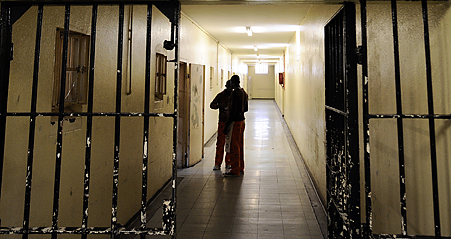
Prisoners talk in a corridor at the Pollsmoor Prison in Cape Town, South Africa on March 18, 2011. (Photo: Stephane de Sakutin / AFP / Getty Images)
It’s talked about in whispers, if at all. But men and boys are all-too frequently subjected to sexual violence, particularly in times of conflict, forced confinement or war. The problem is persistent and global. For the most part, though, nobody wants to talk about it. Over the last few months, however, a handful of reports from West Africa show that rape and sexual violence are being used as a weapon against men and boys, as well as women and girls. In a dispatch for the Observer, British journalist Will Storr chronicles the stories of men raped during the conflict in Congo. In Kampala, Uganda, he meets a refugee who was kidnapped and then raped three times a day, every day, for three years. “There are certain things you just don’t believe can happen to a man,” he said.
Indeed, sexual violence against men and boys, though common, is little understood or studied. One notable exception is the work of UCLA’s Lara Stemple, who looks at the phenomenon of male rape through the prism of international human rights. Though females are certainly more likely to be raped in conflict, she finds, males comprise a “sizable minority” of victims. There are documented cases in conflicts in Chile, Greece, Iran, the Democratic Republic of Congo and other places, too. At a torture treatment center in London, 21% of Sri Lankan Tamil males said they’d experienced sexual abuse during the war, she notes. One study of the conflict in the former Yugoslavia found that 80% of the 6000 inmates at a prison camp in Sarajevo reported rape.
The Abu Ghraib fiasco was a high-profile example of sexual violence in a military detention center. However, rape is also prevalent in civilian facilities. One in five male inmates in America said they’d had a pressured or forced sexual encounter while incarcerated, one study found. In South Africa’s overcrowded, under-funded prisons, rape and sexual violence are used to define and maintain a strict social hierarchy in which “victims are humiliated, dominated and feminized,” Stemple writes. Here, as elsewhere, men who identify as gay, or are perceived to be ‘feminine’ are particularly susceptible to abuse. (See also Ross Kemp’s investigation of sexual violence in one South African prison.)
Shame and social stigma silence many survivors. They are often plagued by injury, ashamed and wary of speaking out. Here’s Storr’s account of one survivor’s life after surviving gang rape and sexual torture in Congo:
Today, despite his hospital treatment, Jean Paul still bleeds when he walks. Like many victims, the wounds are such that he’s supposed to restrict his diet to soft foods such as bananas, which are expensive, and Jean Paul can only afford maize and millet. His brother keeps asking what’s wrong with him. “I don’t want to tell him,” says Jean Paul. “I fear he will say: ‘Now, my brother is not a man.'”
It is for this reason that both perpetrator and victim enter a conspiracy of silence and why male survivors often find, once their story is discovered, that they lose the support and comfort of those around them. In the patriarchal societies found in many developing countries, gender roles are strictly defined.
Though patriarchy and homophobia are certainly not limited to poor countries, Storr rightly highlights the ways in which stigma prevents men from getting help. Survivors are often assumed to be gay, which is a crime in 38 of 53 African nations and carries considerable social stigma elsewhere. Also, relatively few groups are able, or willing, to help male survivors. In her paper for Hastings Law Review, Stemple notes that of the 4000+ organizations that address rape as a weapon of war, only 3% mention the men in their informational materials. And few doctors, anywhere, are trained to recognize signs of male rape, or counsel survivors, she says.
There is concern, too, that highlighting male rape will somehow take away from efforts to stop sexual violence against women. I understand the fear, but think it short-sighted. Talking about sexual violence against men and boys helps shatter stigma, which, hopefully, will result in more support for survivors. It also challenges rigidly-defined gender roles that cast men as hyper-masculine sexual aggressors and women as passive victims. Tackling this narrative is one step toward ending violence against women, as well violence against men.
More: Read about sexual violence in the Democratic Republic of Congo.
Emily Rauhala is a writer-reporter at TIME. Find her on Twitter at @emilyrauhala. You can also continue the discussion on TIME’s Facebook page and on Twitter at @TIME.