


Brazilian Navy sailors pick up a piece of debris from Air France flight AF447 out of the Atlantic Ocean, about 745 miles (1,200 km) northeast of Recife, June 8, 2009. (Photo: Reuters) 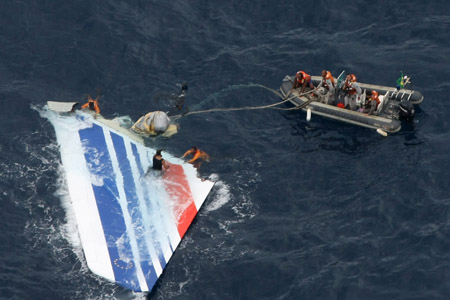
It didn’t take for confirmation of our warning last week that the initial report into the causes of the 2009 crash of Air France flight 447 wouldn’t stifle debate about who was to blame for the calamity. Less than a week after France’s official Bureau of Investigations and Analyses (BEA) issued a preliminary finding stating insufficiently trained pilots of the doomed Airbus A330 failed to address a resolvable stall of the craft, France’s leading pilots’ union and families of victims are attacking the organization and its study as being manipulated by French business interests. The SNPL union said it was suspending its participation in the BEA’s inquiry after French media revelations Wednesday that the agency made last-minute deletions of a section in the study raising questions about the plane’s stall warning system—concerns that could have considerable consequences aviation giant Airbus.
French media reported that working drafts of the BEA investigation contained a recommendation Airbus’ stall-warning system be tested for safety—a section deleted shortly before the study’s July 29 presentation. Alarms signaling what ultimately became a fatal stall of the plane sounded a dozen times during the craft’s four-minute fall to the Atlantic, a flurry of alerts the draft report said “strongly contributed to the difficulty of the crew to analyze the situation”. Moreover, the stall alert may have shut off and restarted in a manner that influenced pilots to alter what perhaps were correct maneuvers they’d taken to resolve the situation—one in which they were deprived of data they needed due to the malfunction of external speed detectors that had frozen. It was apparently due to the confusion caused by the alarms that the BEA’s draft report suggested the stall alert system be thoroughly tested for safety in even rare and extreme flying situations.
Following the publication of that deleted section Wednesday, the BEA justified its move saying technical experts in the flight 447 inquiry felt there was still insufficient evidence of the alarm system’s contributing role in the crash to retain it in the initial July 29 finding. For that reason, the published document primarily focused on observations that the pilots had never received training in the high altitude manual flying mode they assumed once the A330’s automatic pilot had been switched off. The report also noted the crew hadn’t been instructed in dealing with extreme or unusual flying situations, such as trying to take remedial steps in emergency situations without having all the data required to calculate such maneuvers. Though BEA officials did note in presenting the preliminary study that the alarms sounding during the final minutes of flight A447’s descent “could have perturbed the crew in its understanding of the situation”, the report’s primary stress on insufficient pilot reaction prompted protest from Air France, pilots’ unions, and victims’ families that the crew was being made a scapegoat for the accident.
That reaction grew stronger in the wake of Wednesday’s press revelations, which renewed allegations the BEA was seeking to protect Airbus from the heavy consequences it would face if components of its aircraft were found to have contributed to the crash. The presumed motive is clear: though the BEA is an independent body, it operates under aviation administrations leading back to the French government–which has an obvious interest in an industrial giant like the Toulouse-based Airbus avoiding troubles that could undermine its multi-billion dollar business activity. French officials have insisted that no ulterior motives or political interference have affected what they call a transparent independent inquiry.
The SNPL pilots’ union doesn’t see it that way. It says it has halted its participation in the BEA investigation on the grounds its confidence in the agency has been “seriously undermined” by what it calls an inquiry that has “transformed into a prosecution case against the crew”. For its part, Air France has officially requested that European air transport safety officials carry out the tests on Airbus stall alarm systems that the deleted portion of the BEA report recommended. Associations representing the families of victims went even further, saying an investigation they had long argued was seeking to protect Airbus and Air France from any blame that might harm the companies had now become “definitively discredited” by Wednesday’s press revelations.
“We now have the confirmation that the claims coming from the BEA’s (government) superiors were not only premature, but void of objectivity, incomplete, and strongly oriented to defend Airbus,” said Robert Soulas, whose daughter was killed in the A447 crash. “The speed with which these officials accused the pilots without hesitation had (already) raised our suspicions. (Wednesday’s revelations) have created an unprecedented crisis of confidence in the investigating authorities.”
In defending itself, the BEA has said the removal of the alert recommendation was motivated by expert opinion that there was not yet enough evidence to officially cite the stall alarm as causal in the crash. Officials also say the disputed section—and anything else relevant to their findings—will be included and fully detailed in their final report, which is due out in the first quarter of 2012. Between now and then, however, the acrimonious debate about how flight A447 and the 228 people aboard went down—and who is to blame for it—is certain to create new alarms of its own.