


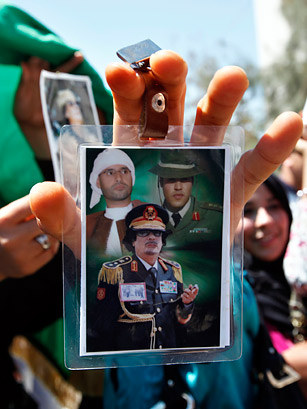
Khamis Gaddafi (R) is seen alongside his father Libyan leader Muammar Gaddafi (C) and brother Saif al-Islam (L) in a picture held by a student near a building at Fatih University in Tripoli in this June 18, 2011. (Photo: Ahmed Jadallah / Reuters)
Libya’s rebels announced this Friday that a NATO air strike on the town of Zlitan — near Tripoli — killed nearly three dozen Gaddafi regime loyalists, including his son Khamis, commander of the feared 32nd Brigade, the country’s most crack military unit. This is the second time Khamis has been reported dead, and the Gaddafi regime has been quick to counter the rumors. A spokesman in Tripoli reiterated the government’s repeated line that NATO missiles are hitting civilian targets, telling Reuters that the rebels’ allegation is “false news. This is a dirty trick to cover up their crime in Zlitan…They invented the news about Mr. Khamis Gaddafi in Zlitan to cover up their killing.”
Whatever the truth, the strike brings into relief the symbolic importance of figures like Khamis as the war in Libya grinds on. Less is known about him than the eldest Gaddafi scion, Saif al-Islam, but Khamis’s leadership has been vital in the regime’s operations against the rebels. As rebel forces slog their way toward Tripoli, it’s believed Khamis and his brigade — numbering roughly 10,000 highly-trained, well-equipped soldiers — have been manning the main line of defense. Khamis’s battalion also was involved in the initial fighting in Benghazi — allegedly with the aid of hundreds of West African mercenaries — that marked the beginning of the full-fledged rebellion that now threatens to topple the four-decade-old Gaddafi regime.But the international war effort, as we’ve documented, is flagging, with some of NATO’s earliest intervention-cheerleaders reportedly keen to sort out a negotiated settlement between Gaddafi and the rebel Transitional National Council. U.S. Senator John Kerry insisted today that Gaddafi “will never run the country again,” but such braggadocio rings increasingly hollow, not least because of the apparent dysfunctions and rivalries emerging within the motley rebel alliance. The assassination of Abdel Fatah Younes, a prominent rebel leader who was once Gaddafi’s right-hand man, exposed the obvious tensions within the TNC.
Gaddafi’s eldest son highlighted the tenuous rebel position in an interview with the New York Times earlier this week. Saif al-Islam, once heralded as a liberal reformer who would guide Libya into the political mainstream, claimed the Gaddafi regime had been in talks with the Islamist faction of the rebel alliance. For years, Tripoli brutally quashed any trace of extremist, Islamist political organization in the country — for a time with cooperation from Western powers. Now, Saif conveniently argues, reckoning with Islamists is the double-bind the West must accept:
“You want us to make a compromise. O.K. You want us to share the pot. O.K., But with who?” he said in imagined dialogue with the Western powers. The Islamists, he said, answering his own questions, “are the real force on the ground.”
“Everybody is taking off the mask, and now you have to face the reality,” he said. “I know they are terrorists. They are bloody. They are not nice. But you have to accept them.” He seemed to enjoy repeating the notion that Western capitals would be forced to welcome the ambassadors or defense minister of a new Islamist Libya.
Saif’s interview should be taken not simply with a grain of salt, but rather a large briny vat of capers. It is, if nothing else, amusing to watch. Saif, who spoke to TIME exclusively a few months ago (see that video here), thumbs prayer beads while smugly dismissing reports of rebel victories. He says the West chose to intervene in Libya because it, unlike some other crisis countries, is “very sexy, very nice.” But it’s hard to dispel the sense that there is genuine cause for his confidence, no matter how cornered his family’s position may be — and even if his younger, shadowy brother now lies dead.
Ishaan Tharoor is a writer-reporter for TIME and editor of Global Spin. Find him on Twitter at @ishaantharoor. You can also continue the discussion onTIME‘s Facebook page and on Twitter at @TIMEWorld.