


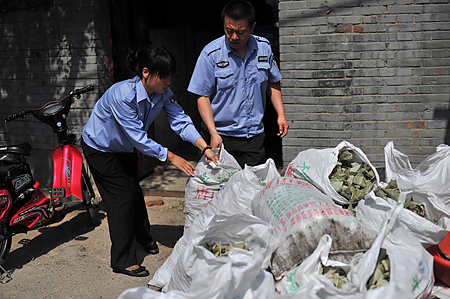
Chinese authorities seize bags of rice dumplings which were made from contaminated rice with sodium cyclamate, an illegal artificial sweetener, at an unlicensed workshop in Beijing, June 2, 2011. (Photo: AFP / Getty Images)
Chinese authorities have arrested 2,000 suspects and closed 4,900 businesses in the latest crackdown on food safety violations. Government investigators have inspected nearly 6 million food and additive producers since concerns about the use of harmful ingredients spiked this spring, the Food Safety Commission of China’s State Council said Wednesday, according to a report by the official Xinhua news service. The latest enforcement campaign shows both the seriousness with which the Chinese government takes the country’s food safety concerns, and the obstacles it faces in trying to prevent another round of embarrassing scandals.
China’s food safety woes date back to at least 2004, when 13 infants in coastal Fujian province died of malnutrition after being fed shoddy formula that had little nutritional value. In 2008 infant formula was also the root of a widespread scandal caused by the use of melamine, a chemical that when added to milk can fool tests for protein content and make it appear more nutritious. At least six babies died and 300,000 sickened after consuming melamine-tainted formula, which can lead to kidney failure over time.
But despite new food quality laws and tougher punishments for violators, safety scandals crop up regularly. This spring Shuanghui Group, the country’s leading meat producer, apologized after some of its pork products were found to be contaminated with clenbuterol, a banned drug that causes pigs to shed fat. When meat tainted by the drug is consumed by humans it can cause nausea. In May the country was hit by another scandal that while not immediately serious to human health, illuminated the heavy reliance on chemicals in Chinese agriculture. On farms in eastern China watermelons began exploding in fields, which was blamed on ill-timed applications of a growth stimulant.
While the arrest of 2,000 suspects will surely help make China’s consumers safer in the short term, the steps needed to carry out such an operation show just how hard it will be for the authorities to ensure quality food production over the long term. The enforcement effort was a coordinated effort by “agricultural, industrial, commercial, quality control and food authorities,” Xinhua reported, which indicates the diffuse manner in which responsibility for food safety has been divided in the 2009 food safety law. Added to that is the overall complexity of China’s massive food production system, which is much more reliant on small producers than the U.S. or Europe. That, combined with China’s overall size, is why this latest crackdown required the inspections of nearly 6 million producers. With so many government agencies responsible for policing so many producers, it is inevitable that some unscrupulous operators will slip through the cracks.
To combat that, Chinese authorities often rely on very public “strike hard” campaigns, that target large numbers of suspects and often result in tough sentences for convicted wrongdoers. The announcement earlier this year that courts should hand out tougher penalties to food safety violators, even death sentences, at a time when China is trying to use of the death penalty, is another indication of how the authorities are trying to achieve better compliance. But the value of such campaigns may be limited, as wrongdoers who survive the current crackdown may feel that they will face less risk once the campaign flags. And the tough sentencing has been shown to have limited effect as well. It’s already been four years since the government carried out its biggest strike against product safety violators, the execution of former Food and Drug Administration chief Zheng Xiaoyu for accepting bribes.