


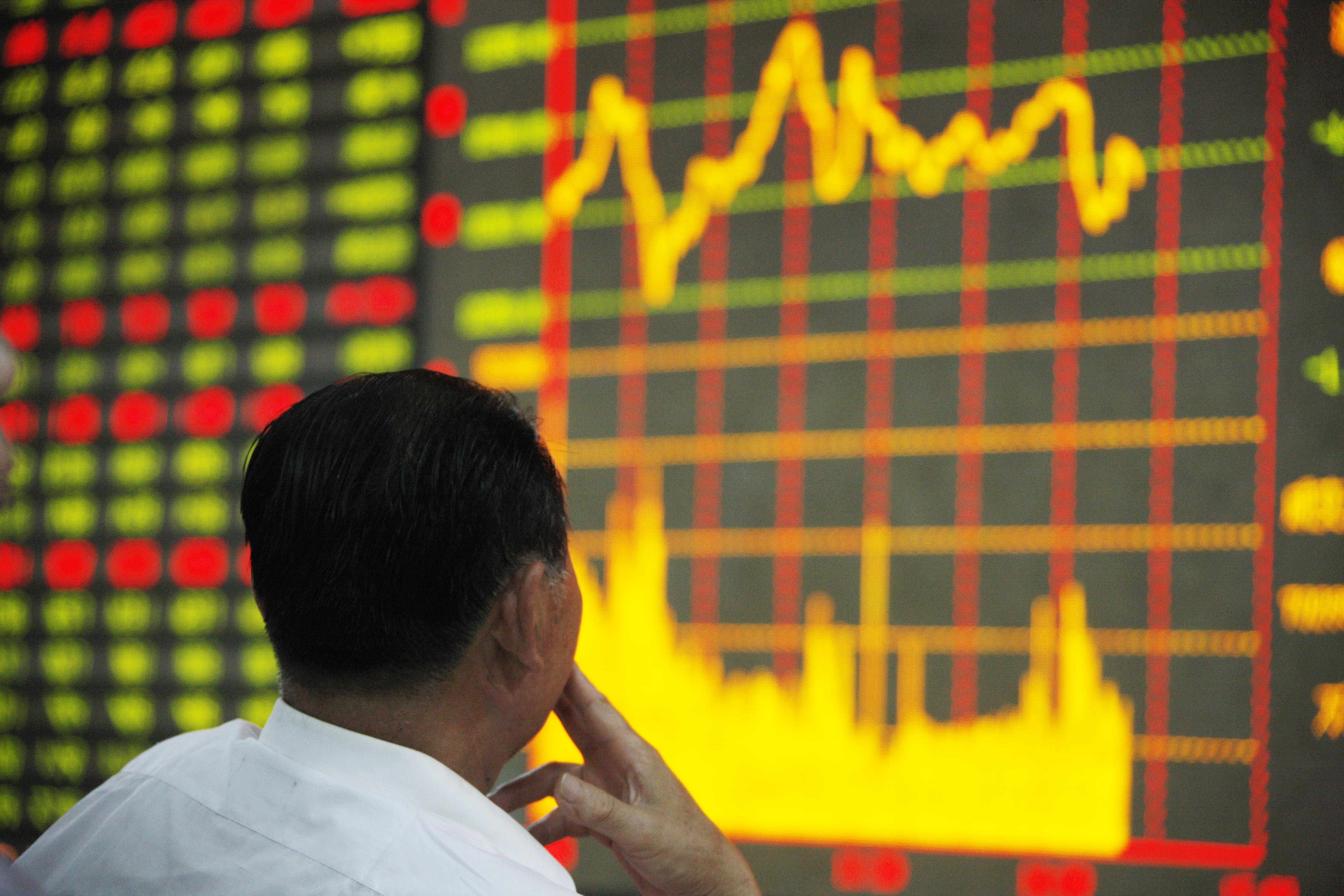
An investor watches the electronic board at a stock exchange hall on July 12, 2011 in Huaibei, China. (Photo: ChinaFotoPress / Getty Images)
Official Chinese media have lashed out at American debt following rating agency Standard & Poor’s decision to downgrade the U.S. credit rating. “The U.S. government has to come to terms with the painful fact that the good old days when it could just borrow its way out of messes of its own making are finally gone,” Xinhua, the state-run news service, wrote Saturday.
China’s central government has traditionally espoused a stance of non-interference in the internal affairs of other nations. Criticism from Chinese officials over the U.S. debate on the debt ceiling have been muted, though in July China’s top military officer suggested the U.S. would be better spending less on national defense. State-run Chinese media outlets have been less reticent to blast U.S. policy. China, which now holds at least $1.16 trillion in U.S Treasury securities, is the U.S. government’s largest foreign creditor. Xinhua noted that China’s role as a leading lender to the U.S. gives it full right to critique the missteps of the world’s largest economy.
The Xinhua article continues:
China, the largest creditor of the world’s sole superpower, has every right now to demand the United States to address its structural debt problems and ensure the safety of China’s dollar assets.
To cure its addiction to debts, the United States has to reestablish the common sense principle that one should live within its means.
S&P has already indicated that more credit downgrades may still follow. Thus, if no substantial cuts were made to the U.S. gigantic military expenditure and bloated social welfare costs, the downgrade would prove to be only a prelude to more devastating credit rating cuts, which will further roil the global financial markets all along the way.
The People’s Daily, the mouthpiece of China’s ruling Communist Party, continued the tough line on Sunday. “The lowering of the United States’ long-term sovereign credit rating has sounded a warning bell for the international currency system dominated by the U.S. dollar,” economist Sun Lijian wrote in a brief commentary, Reuters reported.
S&P’s decision to lower the U.S. credit rating was proceeded last week by a downgrade of U.S. debt by a less-known Chinese rating agency, Dagong Global Credit Rating Co. It was Dagong’s second such downgrade, moves Xinhua painted as prescient. “Now S&P has proved what its Chinese counterpart has done is nothing but telling the global investors the ugly truth,” the Chinese news agency said in its report Saturday.