


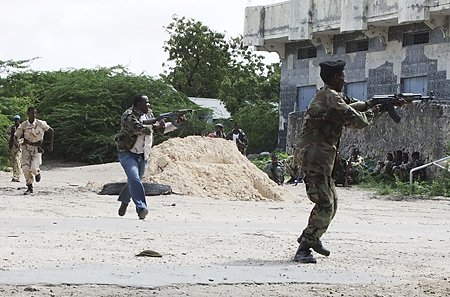
Somalia Transitional Government soldiers prepare to take positions near Mogadishu stadium after a brief fight with Al Shabaab fighters, August 7, 2011. (Photo: Farah Abdi Warsameh / AP)
All war is chaos, but after 20 years of fighting Mogadishu resembles perfect anarchy. The streets are surfaced with decades of compacted garbage and to drive them is to be tossed about like a small boat on a rough sea. The buildings still standing are pock-marked with hundreds — generally thousands — of holes from bullets, artillery and RPGs. But most are ruins, all crumbled walls and blown out facades being swallowed by thorn scrub and monstrous Bougainvillea, evidence of the gracious Italianate gardens that once decorated villas across the city. The roof over the cathedral in the city center has collapsed, leaving the buttresses exposed like the gray ribs of some felled giant, while one of the two giant pillars that used to frame its entrance has collapsed, transforming its partner into an ironic, tottering minaret.
The unpredictable evolution of Mogadishu’s wars encapsulates its turmoil. Over the years, the conflict has involved clan warlords, U.S, soldiers, African soldiers, U.N. peacekeepers and Islamists. In the past five years, the Islamists beat back the warlords, were themselves expelled by invading Ethiopians, then fought their way back into the city against the official Transitional Federal Government (TFG) and their allies, Ugandan and Burundian troops from the African Union (AU). The most powerful Islamist group, al Shabab, absorbed all the others and only a year ago its strength was apparent: last year, it came close to taking the entire city and also signalled a violent international ambition, detonating simultaneous suicide bombs in the Ugandan capital, Kampala, in July, killing 76 people. But in the last few months, al Shabab has split into two different factions, a famine has devastated areas of southern Somalia under its control and the AU and TFG militias have taken the fight to al Shabab in Mogadishu. At the weekend, vowing to return, the Islamists pulled out of the capital.
At least, that’s what the government said. But there are rumors of Shabab fighters still in the city, and gunfire still cracks every few minutes across the sky, so to check, we decided to drive to Bakara Market. The market is jointly infamous as Somalia’s arms bazaar and the place where one of two US Special Operations helicopters crashed in Blackhawk Down, and for the past few years it has been al Shabab’s Mogadishu stronghold. Our plan is simple: if al Shabab really are gone, Bakara should be empty. We have our own little militia — eight gunmen with AK-47s and heavy caliber machine guns, who ride ahead on the back of a pick-up. But to move across Mogadishu, you need the blessing of any militia operating in the areas you transit. And getting that takes time.
We drive to the presidential palace to seek advice there. We follow Somalia’s interior minister to a collection of refugee camps deep in the ruins of the city, where he shows us a small hole in the ground, the site of an explosion an hour before. It’s not the handiwork of a Shabab suicide bomber, as we first thought, nor that of a man trying to sell a bomb he had found, as we were initially told, but of a child playing with what he thought was a toy. The Interior Minister, Abdisamad Mo’Alim Mohamud Hassan, is anxious to demonstrate both the city’s new safety and the ongoing tragedy befalling its most innocent civilians. We return once more to the presidential palace. Everywhere we go, in the streets, on every piece of wasteland, are tiny conical huts made from twigs, rags and plastic bags, home to hundreds of thousands of refugees from Somalia’s famine — 470,000 according to Western aid agencies, perhaps twice that according to Somali ones.
Finally, the call comes. A TFG militia leader will meet us in Bakara. We race through the streets, through an AU checkpoint, beyond the old frontline and, next to a wrecked spectators’ stand where Somalia’s government once held independence parades, 15 gunmen roar up on a technical — a pick-up mounted with a heavy caliber machine gun. We ride through the back streets, getting over closer to Bakara. My companion, Mo, a journalist who used to sneak into Bakara to interview al Shabab but has been unable to visit for two years, expresses mounting excitement. “This is the edge of Bakara,” he says. “This is Bakara… This is the main street in Bakara…” We dismount into an alley of stores, all shuttered but gaily advertising their services with great multi-colored montages: airplanes, burgers and extracted teeth. Our militia escort is led by a colonel, Usman Abdullah. “It’s calm now,” he says. “Al Shabab have run away. There are a few skirmishes but the leaders are gone. We are protecting the market from looters.” A small foot patrol of sweating Ugandan AU soldiers enters the street and passes without a word. Then a single black SUV approaches, and a blacked-out electric window descends to reveal the face of General Yusuf Mohammed Siad, better known as Inda’ade, or “White Teeth.” Inda’ade is an old Somali warhorse, a clan militia commander, warlord and occasional government minister who has fought almost continuously for the last 20 years. The Shabab have definitely gone, he says, and soon the TFG will control all of the city. How can he be so sure? “I know their tactics,” replies Inda’ade. How’s that? “I used to be one of them,” he says without missing a beat. “And now, God willing, we will finish them all.”