


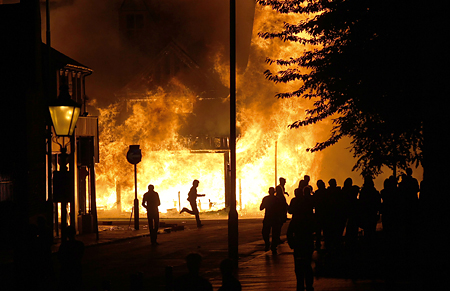
A shop is set on fire as rioters gather in Croydon, south London, Monday, Aug. 8, 2011. (Photo: Sang Tan / AP)
With the violence that broke out in London Saturday having spread to other English cities during a third straight night of rioting Monday, it’s tempting (and probably portentous) from the comfort of Paris to offer up lessons learned from the nearly three weeks of upheaval that rocked French towns in 2005. Yet while there seem to be certain details common to both those explosions of urban fury, significant differences not only complicate directly comparing events in the U.K. to those that occurred in France nearly six years ago—but also leave the current unrest looking more serious in terms of destruction and consequence. As shocking as the images of burning cars, vandalism, and clashes with police were in 2005, the scenes today from across London inspire an even stronger, awesome fear. Here’s why.
The detonators of both uprisings appear to have been similar: first, police involvement in the deaths of local youths in neighborhoods with large populations of visible minorities, followed by the fury — nourished with wider frustrations of discrimination and alienation — that those killings unleashed. And as happened in 2005 France, the initial unrest that broke out Saturday in Tottenham has gradually spread to other areas of London and to two other British cities as young people have embraced the underlying message of social protest and rage—or used them as convenient excuses for running amok. Not insignificantly, the spread of violence in both cases also provoked laments-cum-accusation that over-dramatization and voyeuristic media coverage early on led to “copy-cat” replication of the urban outrage.
From there, however, things seem to get different in important ways–starting with urban geography. The Paris suburb of Clichy-sous-Bois that initially erupted in unrest in Oct. 2005 is just that: one of the many towns hosting huge but decrepit housing projects for increasingly disenfranchised segments of French society. Those large clusters of projects are almost invariably located in relatively remote suburbs ringing most major French cities, sparing France the kinds of intra muros ghetto areas that cities like New York, Chicago, or Los Angeles have—or neighborhoods with very large non-white, often economically disadvantaged populations as London does.
(SEE: Pictures of the riots in London.)
In stark contrast to the districts in London now suffering violence, therefore, virtually all unrest that rocked France in 2005 occurred in these project-heavy outlying suburbs. And for all intents and purposes, the nightly clashes in 2005 France were never exported anywhere near the businesses, shops, and primarily white, affluent residents of French city centers. The recurring destruction that stunned wider French society in 2005 essentially involved its most disadvantaged and alienated members wrecking havoc in their own, very remote backyards.
As anyone watching the images of destruction knows, the rioting in the English capital and other cities is now surging right up to the doors of comfortable, middle and upper-middle class homes. The reasons: the sprawling nature of London makes it a much geographically larger and a far more populated city than intramuros Paris. Meanwhile, like France’s blighted banlieues, the London neighborhoods now suffering turmoil have heavy immigrant and visible minority populations airing complaints of discrimination, endemic unemployment, and tense relations with police. Yet these populations are part of a wider, mixed residential pool. Indeed, unlike France 2005, the Watts or South Central riots in Los Angeles, or instances of arson and looting in New York’s Harlem, objectives of “containment” by officials in reacting to violence those cities are non-starters in London—whose mixed socio-economic-ethnic demographics make the current violence an equal opportunity threat. It numbs the mind to contemplate what kinds of new attacks on multi-culturalism will surge in Britain once the waves of nightly violence subside.
If so, Londoners of all stripes will have to learn again to live together in a way Parisians and their banlieusards haven’t even attempted to for generations. The divide is that complete, due mostly to the reinforced-ghetto nature of many French projects. Indeed, one of the biggest complaints that France’s banlieue residents continue airing is how their geographical remoteness from the centers of France’s main cities only the most evident form of their exclusion from and rejection by wider, productive, profitable French society. Transportation to and from projects into city centers is limited at best, and it takes significant effort for residents to jump what’s become known as the “invisible wall” separating them from the turf of wider French society. This, indeed, was a major reason why when rioting broke out in 2005, the burning cars and pitched battles with police were limited to the suburbs: that’s where the anger was created, grew, festered and exploded; seeking to export that into the areas that white, comfortable France calls home would have left rioters dissipated, disorganized, and exposed so far from their bases.
Conversely, in London—and the other English cities in which unrest is now flaring up—the people doing the most damage are believed to live among relatively well-off working families. And they are far more mobile: it now seems quite clear that youths who first ignited the violence to protest the death of one of their own have been joined by a far wider array of trouble-makers. Those may include well-organized anarchists central to mass violence during demonstrations over rising university fees, as well as opportunists who figure regular explosions of vandalism provide them good cover for looting. That intersection of different actors and motives probably explains the rising number of rioters, and geographical spread of the unrest.
Only time will tell whether the nightly uprisings will continue to proliferate in England as they did in France. But it already appears that the first three nights of London’s riots involved a higher number of far more diverse actors in relative terms than those involved at the start of France’s three-week nightmare. That big early turn out can probably be explained by the bigger population pool and more easily accessible nature of London neighborhoods compared to more isolated French banlieue; the former also boast far more shops and businesses vulnerable to looting.
Those differences are among the reasons why French citizens living in London have blogged, written letters in traditional media, or posted warnings on forums advising people back in France from assuming the London unrest is simply an updated version of 2005. It’s also doubtless why British commentators have described scenes of the violence as having a similar intensity and destructive power as the WWII German Blitz. Though the war-time descriptions are perhaps a bit over-stated, one understands the sorrow and alarm behind them: whereas the answer to the 2005 question “Is Paris Burning?” was a thankful “no”, London has not been similarly spared in 2011. London is being once again bloodied—in some cases in its historical urban flesh in a way Paris residents shudder to even imagine.
There’s also a bit of a shudder at work in trying to figure out how to stop the wreckage. Unlike 2005—when France’s government was able to promise more money, new business investment, better transport, and the replacement of the worst housing projects with newer construction—the austerity-focused UK government of David Cameron doesn’t have the option (or money) of seeking to buy renewed calm from protestors. (Indeed, their anger may in part arise from the pain being felt as cuts in social programs and benefits have cut in from Cameron’s debt reduction efforts.) Whether accurate or not, Cameron now risks facing accusations his policies created a lot of the discomfort and hardship, and may have hampered the policing the riots may have sprung from. The riots could call into a question many of the austerity measures he has staked his government’s legacy on. A spot between a rock and a hard place would be a comfortable place by comparison.