


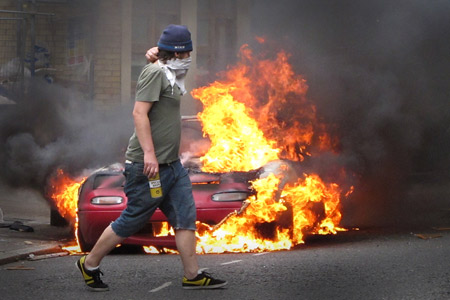
A man walks past a burning car outside a Carhartt store in Hackney on August 8, 2011 in London, England. (Photo: Peter Macdiarmid / Getty Images)
To reduce the riots that have shaken Britain this week to nothing more than criminal wickedness, as Prime Minister David Cameron and his cohort tend to do, is a dangerous exercise in denial. And it barely survives the most cursory scrutiny: Thousands of people don’t suddenly take to the streets to manifest wickedness as if in response to the appearance of Lord Voldemort’s Deatheater sigil on their Blackberries, without any context; criminality — which the actions of the rioters certainly are, with no mitigating features or excuses — on the massive scale seen in London this week is indicative of a social crisis. And to dismiss as apologists for thuggery those who seek explanations in the state of society for a mass outbreak of criminality is a self-serving, self-deluding evasion by those in power. When so many young people have been so willing to break the laws that maintain order and protect property rights, it doesn’t require a Marcellus to point out that there’s something rotten in the state of Britain.
Criminals, by definition, defy the social contract, and yes, there may very well be a gang culture prevailing on the streets as Cameron maintains. But those smashing storefronts and helping themselves to the merchandize inside, or mindlessly breaking and burning stuff or hurting innocent bystanders may simply be a vicious, greedy, selfish, apolitical and opportunist (and obviously intolerable) iteration of a far broader discontent.
Last November, a protest by hundreds of thousands of students against the Conservative-led government’s cuts to education spending turned into an ugly clash with police. Earlier this year, in March, as many has half a million Britons took to the streets of London in to protest — mostly peacefully, although small groups broke away and engaged in vandalism and clashes with police — against the Conservative-led government’s massive cuts in spending on education, health and public services. And even when the dust has settled from this week’s riots, more anti-austerity protests are likely in the months ahead. Those young people who turn out to peaceful protests against government austerity programs have little in common with those who have been looting stores, but both are arguably symptoms of a breakdown in the social contract: Simply working hard and playing by the rules is no longer a path to prosperity or even a dignified future in much of the industrialized West, where neoliberal economic policies have funneled most of the wealth created in recent decades to a small, already wealthy elite, while shrinking the middle class finds its living standard steadily declining, and more than one in five young people is unemployed with no prospect of finding work in the foreseeable future.
The looters respond to their circumstances by simply breaking the rules and grabbing whatever they can, while the moment — and their capacity to hurt anyone who gets in their way — allows it. The protestors, who are far more numerous, despond by demanding that the rules be changed, and they’re on the streets because they believe that even the democratic political system has failed them, producing governments in thrall to the interests of financial elites regardless of which party dominates. And the British anti-austerity programs are echoed on the streets of Madrid and Barcelona, Rome and Lisbon, Athens and Tel Aviv — an Austerity Intifada is sweeping Europe.
The term “looting” commonly describes the actions of those who help themselves to the merchandize of stricken stores when social order breaks down. But many of those in the more orderly protests on the streets of Europe accuse the Western world’s bankers of doing the same to the state, demanding bailouts to save them from the consequences of their catastrophic mistakes, leaving them sitting pretty while public debt balloons and the middle class and poor are expected to shoulder the burden of austerity.
Whether they respond with disciplined protest or nihilism and criminality, millions of young people in Europe today see playing by the rules of the socio-economic and political status quo as offering them no decent future. Politicians may comfort themselves with the notion that the social unrest on the streets is simply a problem of a “culture of irresponsibility” and deviance, but if mainstream society is unable to integrate whole swathes of its youth population and give them a stake in playing by the rules, it’s going to face growing discontent.
A widely quoted study published this month by Euroean academics Jacopo Ponticelli and Hans-Joachim Voth, shows a clear and consistent correlation between government spending cuts and social unrest in Europe over the past century. And the protests that have shaken Spain, Greece, Portugal, France, Israel and Britain this year (even before this week’s rioting) suggest that the pattern continues. The orgy of looting and vandalism that Britain suffered this week may have been simply the ugly Halloween face of a far broader wave of social unrest that expresses not simply economic discontent, but the declining legitimacy of the political system in the minds of millions of people who see it as serving the interests of a narrow elite at the expense of the majority.
More vigorous policing will drive the thugs off the streets and restore a tenuous calm. But keeping them off the streets, and integrating them — and the hundreds of thousands who have poured onto the streets in peaceful protests — into a socio-economic system that offers them a future and a stake in social stability is a challenge that may be nearing crisis proportions.