


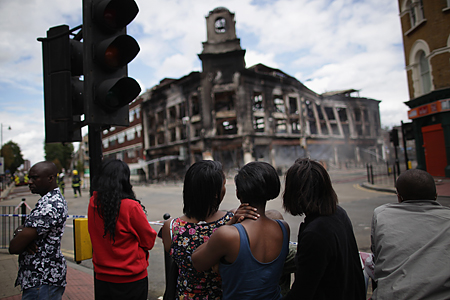
Residents watch as a building burns after riots on Tottenham High Road on August 7, 2011 in London, England. (Photo: Dan Kitwood / Getty Images)
As the crow flies Tottenham is eight miles from the center of London. As the traffic creeps, that translates to 45 minutes by car. The route takes one through the boroughs of Islington and Hackney—the latter still largely poor, but streaked by pockets of growing gentrification. To the right for much of the route one can see a mass of cranes flocked around what will be the Olympic Park when London hosts the summer games next year.
Throughout the commute, the faces of London’s staggering diversity rear up: Arabs in keffiyahs, dreadlocked Jamaicans, Hassidim in kipa and dark suits. African restaurants sit next to Chinese buffets and taquerias – often with signs only in their native languages. And then you reach Tottenham: the most ethnically diverse area in all of the U.K., where, according to the last British census, some 300 languages are spoken. Large communities of Colombians, Congolese, Albanian, Kurdish, Turkish-Cypriot, Turkish, Somalis, Irish and Portuguese all call Tottenham home. And given the area has the highest unemployment rates in the city – especially amongst the young — it’s not surprising that rival ethnic gangs have staked out complicated territories here and that youth mob vigilanteism is common.
So, it is perhaps unsurprising that Tottenham High Street became Ground Zero for the riots that have swept across London this week. Last Thursday, police shot dead suspected drug dealer Mark Duggan in a highly public raid. A Saturday night vigil demanding justice for Duggan, who was of Afro-Caribbean descent, turned nasty and set off the first riot, which rampaged more than half a mile down Tottenham High Street, burning out an apartment building that had survived the Blitz and several stores. British police have launched an inquiry into the shooting after it was revealed that Duggan had not fired his weapon before police dragged him from a mini-cab and shot him dead. A bullet lodged in a constable’s radio turned out to be police-issued.
This Wednesday, hundreds of police were “sterilizing” the half-mile riot scene along Tottenham High Street. The road, which is a main artery to the northern suburbs, was closed off, causing traffic nightmares for London commuters. Forensics teams in what looked to be hazmat suits scoured looted stores for incriminating evidence. Road crews worked to fix wrecked pavement and fire inspectors examined the gutted buildings. “[The youth] feel robbed, so they robbed,” says a 25-year-old man of Jamaican descent who would only give his DJ name, Black Storm. Storm was smoking a cigarette, waiting in vain for a bus to Enfield that would never come. It was temporarily rerouted, he found out, because of the disturbances. “I don’t agree with what they done, but I see why they’re angry. They feel the government is taking away their livelihood.”
British austerity measures have hit low-income areas like Tottenham especially hard. “Protect our school from the cuts,” read giant block letters affixed to a school fence a couple of blocks away from the riot scene. Still, not everyone was convinced. “They started life with so many more advantages than me,” says Viktor Nyics, 32, a mini-cab driver from Budapest, Hungary. Nycis arrived in Tottenham in 2009 speaking hardly a word of English. But he worked his way up and now leads a comfortable life. “They could work but they don’t want to. They just expect to be taken care of. They take and take.”
Tottenham has been the site of riots in the past. In 1985, the area, alongside other volatile parts of London, saw race riots after a police raid scared a local black resident into heart failure. In the years since, many of the laws that provoked racial friction were repealed and the police have gone through an inquiry and reformation process to make the force more diverse. In fact, the unit that killed Duggan – a Scotland Yard outfit known as “Trident,” which works to lesson drug crime in poor areas – was supported by local authorities.
Certainly, these riots seemed to have less to do with black versus white tensions – Somalis are the largest African group in Tottenham and they had little to do with the rioting – and more to do with economic inequity and frustration. Among the smoldering remains of buildings and shopfronts on Tottenham High Street, it’s still hard to spy signs for progress and hope.