


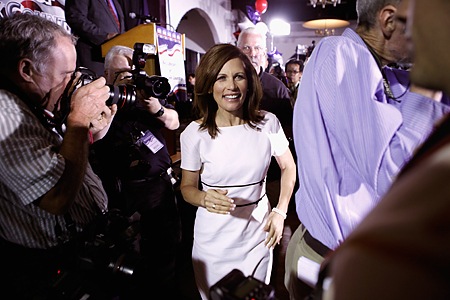
Republican presidential candidate Rep. Michele Bachmann (R-MN) arrives at the Blackhawk County Republican annual Lincoln Day Dinner at the Electric Park Ballroom August 14, 2011 in Waterloo, Iowa. (Photo: Chip Somodevilla / Getty Images)
Michelle Bachmann and Rick Perry may be going head to head for the first time in Waterloo, Iowa tonight, but at London’s Waterloo Tube Station Monday morning, commuters couldn’t read enough about their showdown 4,000 miles away.
News of the Ames straw poll and Perry’s South Carolina campaign announcement have flooded British papers for days now. Readers seemed much more interested in how Bachmann matches up with 2008 Vice Presidential nominee Sarah Palin than Member of Parliament Harriet Harman’s accusations that Tory budget cuts caused the riots, or why her colleague Hazel Blears didn’t appear to remember that young hoodlums weren’t in school because it is summer vacation. Likewise, Perry’s colorful stances on Texas secession and the death penalty trumped German Chancellor Angela Merkel’s backbiting at French President Nicolas Sarkozy.
Perry’s announcement and the funnel cake served at the Ames Straw Poll led the Sunday Telegraph’s international section, ahead of the drought in Somalia and the Syrian government’s suppression of Arab Spring protests. The Sunday Times spent more inches on Perry’s guns and Bachmann being “The Queen of Rage” than fresh allegations that the man whose death at the hands of police sparked the riots, Mark Duggan, had pulled a gun before he was shot. Oddly enough, most papers referenced Waterloo to the Abba song over Britain’s historic victory over Napoleon.
It’s fascinating to watch Britain’s fascination with American politics. And to answer the question I’ve most often been asked by Londoners in the last two days: No, Michele Bachmann is not going to be the next President of the United States. Don’t get me wrong, she’s in a good spot and may yet win down the road, but there’s about a million steps between now and Iowa caucuses, let alone the general election.
The Ames straw poll consists of 16,000 hardcore Iowan Republican voters. There’s not even a guarantee that they are Iowan, frankly. And if you’re really devious, you can probably vote more than once. Voters are as lured by the free food and music politicians dish up than they are swayed by fiscal or social policy. The results are about as reliable as an online poll, which is to say: interesting but more an indication of momentum than actual organization or support.
Across the pond, there is a clear British interest in the impending U.S. presidential campaign that transcends an interest simply in whom will set American policy affecting Europe. At the 2007 Ames straw poll I only noticed two British reporters. Judging by the bylines on and off air, this year there were a dozen. I was shocked Memorial Day weekend when the Times of London invested not one but two reporters to dog Sarah Palin’s week-long road trip up the east coast.
Some of the coverage is clearly appalled: the photos of Bachmann that the Times and the Guardian chose to run rivaled Newsweek’s recent cover for flattering. The Independent went a step further “sounding an alarm” at “the prospect of the arch-conservative Republican representative from Minnesota, Michele Bachmann, winning her party’s nomination to run for President.” American allies who were deeply troubled when George W. Bush was elected to a second term welcomed Barack Obama with open arms. Watching these presidential primaries, many among the Fleet Street set worry America could be turning right – and away from them – again.
But, let’s not get ahead of ourselves. Bachmann is by no means a shoo-in. And Perry’s entry on Saturday may not round out the field. Sarah Palin is still toying with a run and a dark horse may get emerge. And, after all that, Obama, though weakened by the economy and his handling of the debt crisis, still has the power of the incumbency. No challenger can rival the visual power of Marine One landing in the outfield of a minor league baseball stadium and the President strutting up to a microphone on the pitcher’s mound — as Bush often did in 2004. We’re a long way away from President Bachmann, so don’t hyperventilate just yet.