


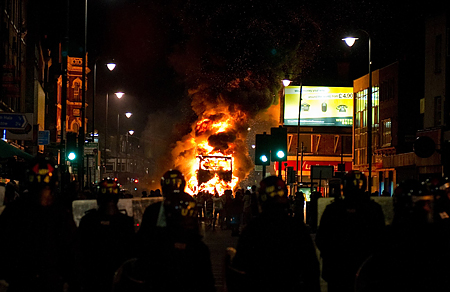
A double decker bus burns as riot police try to contain a large group of people on a main road in Tottenham, north London, on August 6, 2011. (Photo: Leon Neal / AFP / Getty Images)
The French have a phrase for circumstances beyond control: “C’est la guerre,” literally “it’s the war.” They might say it, with a shrug, as they sit in traffic or wait for a bus that never arrives. But last week the expression, which dates back to World War II, took on a different inflection as residents of a village on the shores of Lake Annecy quizzed me about events back in England. “Qu’est ce qui se passe en Angleterre?” they asked. “C’est la guerre?” As British politicians rushed back from their holidays for an emergency sitting of parliament to address that question, I had headed in the opposite direction and found myself attempting to puzzle it out from a distance.
The riots that started in London on Aug. 8 and spread to other cities including Birmingham, Liverpool, Manchester and Nottingham appeared at first glance to mirror the street battles that burned in Paris in 2005 and kindled further unrest across France. But, as my colleague Bruce Crumley pointed out, the French conflagrations remained almost entirely contained in the poorest suburbs, leaving city centers unscathed. By contrast, English main streets and residential terraces were reduced to smoking rubble, evoking memories of the Blitz.
So c’est la guerre in England? And if so, what kind? Class war? The old class divisions may have blurred but inequalities have also widened and social mobility has stalled. Yet among the 2,766 arrested by Aug. 15 in conjunction with the disorder (which for now, at least, has quietened), by no means all of the suspects could be described as poor or lacking in opportunity. Their numbers reportedly include university students and graduates, a graphic designer and a social worker.
A race war? Absolutely not, although the shooting of a black man by police provided the initial spark, and members of the far right English Defence League formed vigilante squads that claimed to be protecting local businesses and ended up in confrontations with police.
A generational war? As I explained in this 2008 story, British kids are more alienated, and more feared, than their counterparts in similarly wealthy European countries. Yet these were not youth riots. Photographs and footage of Tottenham, Croydon and other hotspots show people of all ages united in mob violence. Of 1,580 arrests so far in London, a minority of suspects—330—are juveniles.
A gang war? Well, Prime Minister David Cameron used an Aug. 15 speech on the riots to promise “a concerted, all-out war on gangs and gang culture. This is not a side issue,” he said. “It is a major criminal disease that has infected streets and estates across our country.” Dying to Belong, a 2009 report by the Centre for Social Justice, an organization founded by Cameron’s party colleague and current Secretary of State for Work and Pensions Iain Duncan Smith, had already furnished useful data on the spread of that disease. “The composition and nature of gang culture has shifted,” it stated. “Gang members are getting younger, geographical territory is transcending drug territory and violence is increasingly chaotic.” Among the statistics cited by the report were these:
- Up to 6% of 10-19 year olds self-report belonging to a gang
- In both Manchester and Liverpool around 60% of shootings are gang related
- Police in London and Strathclyde [the Strathclyde force covers a 5,371-square-mile chunk of Scotland including the city of Glasgow] have each identified 171 and 170 gangs respectively
The last set of figures shows why England’s riots cannot be simply laid at the door of poverty or gang culture. Though a child born in a hardscrabble part of Glasgow is more likely to join a gang and faces at least as many disadvantages as a kid from a London slum, Scotland has avoided, at least for now, the riots.
That is not to exonerate gangs but to suggest that some of the same forces redefining gang culture and creating the gangs that reveled in England’s riot-torn streets also created the conditions for the riots. These forces include the chemical reaction between the factors that do not carry the can individually: poverty, alienation, lack of opportunity and aspiration and simmering resentments among different segments of the population competing for limited resources. But politicians, briefly in accord as riots flared, are now fighting battles of their own, lobbing ideological bricks as they claim to understand the underlying causes of the malaise. For Cameron, in his Aug. 15 speech, the culprit is Britain’s “slow-motion moral collapse,” driven by the breakdown in family structures, over-dependence on state benefits and rising criminality. Labour opposition leader Ed Miliband, speaking on the same day, echoed a magnificent jeremiad by British journalist Peter Oborne, who declared that “the criminality in [English] streets cannot be disassociated from the moral disintegration in the highest ranks of modern British society.” Miliband bemoaned a “crisis of values.” The looters were “greedy, selfish and immoral,” he said, but so too were MPs “who fiddled their expenses” and “the people who hacked phones at the expense of victims.”
It’s not fanciful to see in the prying and spying of British tabloids and the excesses of bankers and the exploitation of the parliamentary expenses regimen by some MPs different flavors of what Miliband called the “me-first, take-what you can” attitudes shared by many of the rioters and looters. Nor is Cameron wrong to discern some roots of what he dubs “Broken Britain” in the atomization of family life. Only connect, as E.M. Forster observed. But the tone-deaf responses of the political elite across the ideological spectrum, their ill-conceived policy proposals and sectarian jibes and the squabbling between police and pols all serve to highlight a damaging disconnect between the establishment and the wider population. Measures already in force or under consideration include evicting those found guilty of disorder from social housing or docking social security payments; both routes carry administrative costs, could edge those targeted into greater criminality and leave whole families homeless or destititute. The government was also quick to raise the possibility of restricting the use of social media in order to prevent people who might be planning disorder to liaise via Twitter, Facebook or BlackBerry Messenger. The move drew cheers—in Beijing. (Another regime usually on the receiving end of criticisms about the repression of free speech misfired in its attempt to portray England’s riots as an anti-monarchy revolution. The Guardian reports that bloggers in Iran have shown photos published by the state news agency purporting to show a brutal police response were taken in different years and other countries.)
The riots are expressions of deep and complex problems. Politicians, police and other institutions are rightly asking what it will take to find a cure. Unfortunately those tasked with providing solutions are also part of those problems. Watching their fumbled responses, the eight miles from Westminster to Tottenham looked almost as far as the 620 miles from London to Lake Annecy.
Catherine Mayer is London Bureau Chief at TIME. Find her on Twitter at @Catherine_Mayer or on Facebook at Facebook/Amortality-the-Pleasures-and-Perils-of-Living-Agelessly . You can also continue the discussion on TIME’s Facebook page and on Twitter at @TIME .