


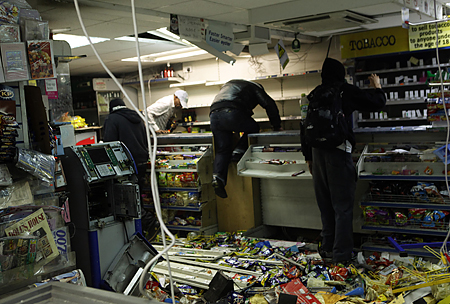
Looters rampage through a convenience store in Hackney, east London August 8, 2011. (Photo: Olivia Harris / Reuters)
London was atwitter Wednesday after a court handed two Cheshire men four-year sentences for trying unsuccessfully to use Facebook to incite riots. Some branded the sentence too harsh; others said it was too lenient. But everyone had an opinion.
“There seems to be a complete lack of proportionality to some of the sentences,” Andrew Neilson of the Howard League for Penal Reform told The Times. “These make a mockery of proportionality, which is a key principal in the justice system.”
But Prime Minister David Cameron was having none of it: “You weren’t in court, I wasn’t in court, it’s up to the courts to make decisions about sentencing,” he said. “They’ve decided to send a tough message, and it’s very good the courts feel able to do that.” Added Communities Secretary Eric Pickles, “Exemplary sentences are necessary.”
British courts have just begun processing the 1,733 people arrested thus far in the wake of the riots. Sentences for those convicted have ranged from four years to metaphorical slaps on the wrist. A 17-year-old Bury St. Edmonds boy who posted messages on Facebook encouraging rioters was ordered to perform 120 hours of community service and observe a 7 p.m. – 6 a.m. curfew for three months.
In the U.S., even such inflammatory messages might be protected by the First Amendment. More importantly, though, the U.S. has, as a matter of policy, sought to actually enable the use of social media to organize protest action when the target is a regime at odds with Washington.
The WikiLeaks cables revealed that Obama Administration worked to set up a global shadow system of phone towers and servers that could be made available to protesters against repressive regimes around the world. One $2 million project funded by the State Department is developing an “Internet in a suitcase”, that could be smuggled across a border and quickly set up to allow wireless communication over a broad area. The State Department has also set up a $50 million cellular network in Afghanistan in case the Taliban cut access to the utility.
Meanwhile, the British government has been looking for ways to shut down access to cell phone texting and social networking if and when new riots break out — a move pushed by Cameron but opposed by his Liberal-Democrat coalition partners. But even if a public security crisis prompted Britain to mimic the tactics of authoritarian regimes and close down social media platforms, don’t expect Washington to challenge them in the name of Net Freedom. After all, Britain would be deemed an ally and a democratic society, seeking ways to protect its citizens from mayhem on the streets. Then again, Syria claims to be doing the same thing. If that seems an easy call, what about Egypt before the U.S. abandoned its long-time ally Hosni Mubarak? Or Bahrain, where it is U.S. allies that are choking off all avenues for peaceful, democratic protest? When is it okay to facilitate facebook-led protests and riots, and when is it not?