


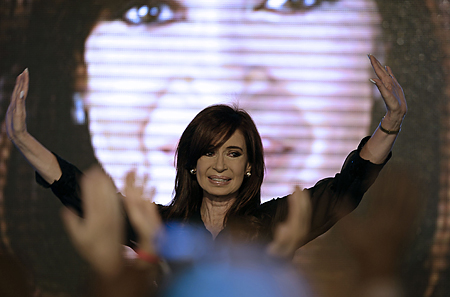
Argentina's President Cristina Fernandez de Kirchner waves to supporters after winning the primary elections in Buenos Aires on August 14, 2011, ahead the general elections to be held on October 23. (Photo: Alejandro Pagni / AFP / Getty Images)
Like most Latin America correspondents, I’ve marked my calendar for October 23: Argentina’s presidential election. Then again, maybe I can just watch NFL games that day, since the race actually seems to have been all but decided last Sunday, Aug. 14. Argentina held its first (and compulsory) open primary voting; but since most parties had already picked their candidates, it turned out instead to be a dress rehearsal for October’s general election. And the result stunned everyone: President Cristina Fernández de Kirchner trounced the field, scoring more than 50% of the vote compared to just 12% for her closest October competitors, former President Eduardo Duhalde and Ricardo Alfonsín, son of former President Raúl Alfonsín.
Given how tumultuous her first term has been, few expected Fernández, 58, of the populist Peronist party, to sweep Sunday’s balloting so convincingly and make herself a seeming shoo-in for re-election. But a number of factors favor her. She continues to draw on a huge wave of sympathy resulting from last year’s death of her husband and presidential predecessor, Néstor Kirchner, whose leadership most Argentines credit with rescuing them from one of the worst economic crises in their history. Today, despite growing inflation and a host of other fiscal dangers, Argentina’s economy is robust, and Fernández can claim it’s because she opted for Peronist-style investment and social spending over IMF-style austerity. Lastly, her opposition is just plain lame.
And yet, it’s hard from abroad not to feel a certain sense of disappointment. Not because Fernández looks all but assured of a second four-year term. But because, at this juncture anyway, she seems to have fallen decidedly short of the regional and hemispheric leadership potential we all saw in her four years ago, when she campaigned for her first term.
Just before the 2007 election, when then Senator Fernández visited the TIME offices in New York, she radiated progressive passion but also a confident ability to steer the unifying paths between capitalism and socialism, George W. Bush and Hugo Chávez, for which her neighbors and kindred political spirits – leftist Latin American moderates like then Brazilian President Luiz Inácio Lula da Silva, then Chilean President Michelle Bachelet and then Uruguayan President Tabaré Vásquez – were so well regarded. Women are the politicians of the future, she told me, because they’re “culturally formed to be citizens of two worlds, public and private…We see the big geopolitical picture but also the smaller daily details of our citizens’ lives.”
But after taking office with a near 80% approval rating – despite criticism that she and Kirchner were conducting a “doble comando,” or dual presidency, with Kirchner still holding the reins – Fernández seemed to turn leftward in a way that associated her, fairly or not, with the more radical geopolitical picture of Latin America’s Chávez bloc. The poised, Hillary Clinton-esque figure we’d watched during her campaign gave way to a more petulant, Eva Perón-esque persona with a polarizing and even authoritarian bent. Critics called her dismissive of the legislative and judicial branches, especially when she nationalized some $30 billion in private pension funds. She embarked on epic confrontations with everyone from farmers, over commodity-export taxes, to private media, which she accuses of political calumny while they accuse her of government censure.
By 2009, Fernández’s poll numbers had plunged below 30%. Her ruling Peronists suffered a stinging defeat in mid-term elections that year that cost them their congressional majority – and seemed to drain Fernández of any international clout she’d once aspired to, despite running South America’s second largest economy. Then Kirchner died of a heart attack last October, and many wondered if Fernández could recover and show the country and the world that she was her own politico.
To her credit, she did. She threw off the elderly and more right-wing guard of her party and focused on promoting a younger generation of leaders – like her current running mate, 48-year-old Economy Minister Amado Boudou, who often campaigns for his boss playing rock-and-roll guitar onstage. A resurgent Latin American commodities boom brought economic recovery to Argentina just in time for her re-election bid, while at the same time the same opposition that clubbed her in 2009 inexplicably turned to stale political names like Alfonsín and Duhalde. And so Fernández on Sunday ended up winning even voter pockets once hostile to her, like Buenos Aires. (Fernández, from a Patagonia province, has long butted heads with the capital’s snooty elite).
(See “In Argentina, Anger Over the New Peronist Chic”)
So what to expect of Fernández if as expected she wins a second term? One hopes she’ll remember her 2009 humiliation and not return to the strident agenda that led her there – that she’ll be a less insular head of state and recognize that the trend of the Latin left today, from Mauricio Funes in El Salvador to (we’re crossing our fingers) Ollanta Humala in Peru, is toward Lula’s model, not Chávez’s. Still, emboldened by her political recovery, Fernández recently pledged to “deepen our model,” which many analysts believe forecasts an even more leftist and “hyper-presidentialist” Cristina.
Some even speculate Fernández will try to eliminate Argentina’s two-term limit for presidents, a la Chávez. (Others, like Miami Herald columnist Andres Oppenheimer, doubt it.) Either way, it might be better for Argentina and the Americas to see four years from now the Cristina we saw four years ago.