What Was Behind the Attack in the Israeli Desert?

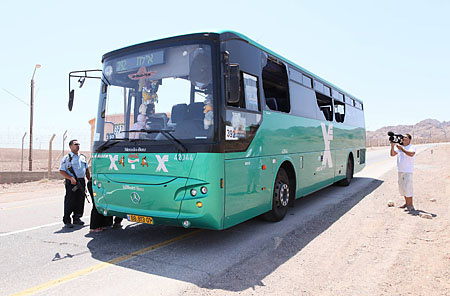
Bus 392 stands on the highway running from Beersheva to Eilat, with windows broken following a gun attack on August 18, 2011 near the Israel - Egypt border, Israel. (Photo: Yehuada Ben Itah / Getty Images)

What headlines described as a terrorist attack in the desert just north of the Israeli resort city of Eilat was in fact a sustained assault, a complex military attack that included missiles, mortars, improvised explosive devices, small arms and, on the bodies of two of the seven assailants killed, explosive vests. Israeli security officials had been tracking the militants from the Gaza Strip, where plans were laid for the attack, into the lawless Sinai desert that since the fall of Hosni Mubarak has offered a more and more accessible back door to Israel. But somehow, the militants found a way to strike first, killing seven Israelis on a lonely desert highway.

“It wasn’t supposed to end this way,” a senior Israeli intelligence officer tells TIME. “And now we have to find out why it didn’t end the way it should have.”

No group claimed responsibility for the attack, but barely six hours later the Israeli military bombed a Gaza target associated with the Popular Resistance Committees, a militant group formed from the more militant remnants of the secular Fatah faction driven out of coastal enclave by Hamas four years ago. Within an hour, three rockets were fired from Gaza toward the Israeli coastal city of Ashkelon. They were knocked out of the sky by the Israeli anti-missile system known as Iron Dome, but the tit-for-tat exchange raised concerns about military escalation between Israel and Hamas, which disavowed the attack but which Israel holds ultimately responsible for threats emerging from the enclave

Read the rest of the story here.
Related Topics: israel, Middle East, Terrorism
  • Latest on Global Spin

    Benjamin Hiller/Corbis

    Must-Reads from Around the World, May 22, 2012

    Summit Struggle - Ahead of Wednesday’s crunch E.U. summit, Der Spiegel reports that new French President François Hollande will pressure German Chancellor Angela Merkel to agree to euro bonds, which she has so far strictly opposed. “Italy and Britain are expected to back Hollande in a further sign that Merkel is increasingly isolated in Europe with her austerity plan for saving the euro,” the German news magazine predicts.

    Yin Dongxun/Xinhua/ZUMAPRESS.com

    Jerusalem Day in the Old City: The Conflict Marches On

    Sunday was Jerusalem Day in Israel, a holiday once again observed by thousands of young Jews who chanted as they marched through Arab neighborhoods conquered in the 1967 Six Day War. The tension is always highest in the narrow passages of the largely Palestinian Old City. So much so that the city’s police this year tried to route the column of youths — most singing patriotic and religious songs, a few chanting “Death to the Arabs” — away from the Arab Quarter. But in the end, the police proved powerless against tradition, and the original route was restored. On Jerusalem Day, marching through the Arab Quarter is the whole point.

    Pablo Martinez Monsivais / AP

    Obama’s Afghanistan Problem: Neither Karzai Nor the Taliban Like the ‘Reconciliation’ Script

    President Barack Obama huddled with President Hamid Karzai in Chicago on Sunday, urging Afghanistan’s leader to accelerate negotiations with the Taliban over a political solution to the longest war in America’s history. But the prospect for Karzai negotiating successfully with the insurgents is clouded by a question raised by Josef Stalin, on the eve of World War II, in response to the suggestion that he offer concessions to the Pope: “How many divisions does he have?” The Taliban now ask the same question about Karzai. And should the Afghan leader also ask himself the question, he might reach a similarly dispiriting conclusion. Karzai’s independent power base is minimal, as is his ability to influence the outcome of his country’s civil war absent direct U.S. involvement. And that gives neither Karzai nor the Taliban much incentive to cut a deal with the other.

blog comments powered by Disqus