


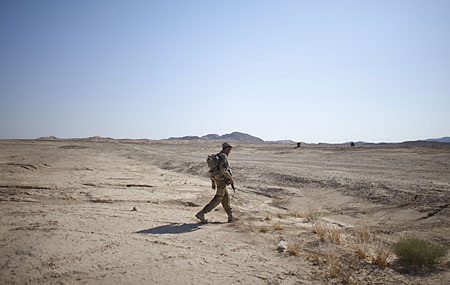
Soldiers set up a check point 60km from Eilat, following series of coordinated gun and roadside bomb attacks against miltary and civilian targets near the Israeli - Egyptian border, on August 18, 2011 in Israel. (Photo: Uriel Sinai / Getty Images)
Any reader of the George R.R. Martin Songs of Ice and Fire series (whose opening book, Game of Thrones, was turned into riveting television on HBO) might see a familiar pattern in the events that threaten to plunge the Israel-Gaza border into a new escalation of violence.
In Martin’s fantasy geopolitics, as in the real world, power is not so much a thing as it is a balance, a state of equilibrium — always ultimately temporary — in a complex matrix of relationships between competing interests, centers of authority and fiefdoms. Any shift in any of the system’s anchors of fulcrums — even interventions by players who wield little direct force of their own but are able to provoke others to overturn the equilibrium — can unleash unpredictable and even catastrophic events before a new equilibrium is achieved. (The attacks of 9/11 would be the perfect example.)
Israel launched air strikes on Gaza overnight that killed at least 6 Palestinians, following Thursday’s attack from Egypt’s Sinai peninsula that left seven Israelis dead. And if that prompts Hamas to dispense with its unilateral cease-fire and launch new attacks on Israel, the Islamists who are the de facto rulers of Gaza will have found themselves dragged into war by a much smaller rival (and occasional ally), the Popular Resistance Committee (PRC).
Israel blames the Gaza-based PRC for Thursday’s attack, saying it was carried out by a group of militants who entered Sinai from Gaza via a smuggling tunnel, and traveled 200 km south before striking at a more vulnerable spot along the Israel-Egypt border. The PRC is essentially a rival to Hamas, composed largely of fighters from the ruling Fatah movement of President Mahmoud Abbas — although the PRC men long ago ceased following orders from the Fatah leadership, and have sometimes made common cause with Hamas against the Israelis.
But Hamas has, since the Israeli month-long military operation in early 2009 that killed more than 1,200 Palestinians in Gaza, largely enforced a unilateral cease-fire, restraining not only its own fighters but also those of rival organizations — the PRC, Islamic Jihad, the al-Qaeda inspired Salafist groups and others — from launching attacks on Israel. But various of the militant groups have at times, in pursuit of their own agendas and frustrated by conditions in Gaza and by the restraint imposed by Hamas, defied the cease-fire and launched rocket and mortar attacks into Israel. But Israel — ironically, perhaps, since it refuses to have any formal dealings with a group it deems an existential terror threat — nonetheless holds Hamas responsible for keeping the peace along its Gaza frontier. When other groups launch attacks, Hamas often pays a price, although both sides appear to have set limits on any escalation in periodic exchanges of fire since early 2009.
There was a time when attacks such as those in southern Israel on Thursday might have been assumed to be the work of Hamas, out to torpedo the peace process. But there is no peace process to torpedo; it sank without trace some years ago without any help from Hamas. And Hamas is facing a potential crisis because its Syrian patron, the regime of President Bashar al-Assad, may be on its way out of power, jeopardizing the status of the Hamas political leadership and headquarters in Damascus. The situation in Syria, and the new possibilities opened up by the overthrow of President Hosni Mubarak in Egypt and the growing influnence of Hamas’ Egyptian founding organization, the Muslim Brotherhood, give Hamas nothing to gain and much to lose by making life difficult for the military leadership in Cairo. Attacking Israel from Egyptian soil makes little sense for Hamas given its current political and diplomatic needs.
And a new crisis in Gaza hardly suits the agenda of President Abbas and the Palestinian Authority: They plan next month to seek U.N. recognition of Palestinian statehood on the 1967 lines, and it hardly helps their case to have the fact that they have no control over events in Gaza — a substantial part of the state they are claiming — so graphically demonstrated.
But for a bit player like the PRC — if, indeed, it was responsible — or any other smaller groups challenging Hamas’ authority and pressing their own claims, the fall of President Hosni Mubarak in February and the weakening of his police state created a new opportunity to slip the shackles of Hamas’ cease-fire by leaving Gaza and launching an attack from Sinai. As our own Abigail Hauslohner has reported, Sinai has become a playground for Bedouin smugglers and various jihadists since Mubarak’s fall, with salafist groups (who share an ideology with al-Qaeda) believed to have been behind repeat attacks on the natural gas pipeline that runs through Sinai to Israel.
Thursday’s attacks came just days after 1,000 Egyptian troops launched an operation in northern Sinai against Islamist cells believed to be inspired by al-Qaeda, which had challenged Hamas in Gaza. Israel gave its approval for the operation — the 1979 Camp David Agreement requires Israeli approval for Egypt to deploy significant numbers of troops in Sinai — and so did Hamas.
The fall of Mubarak had created a vacuum in Sinai into which some of Hamas’ rivals have been able to move to provoke a confrontation that Hamas had been trying to avoid. But once the Israelis are bombing Gaza, Hamas may find it difficult or impolitic to restrain its own armed wing, or other groups from firing at Israel. So the danger of escalation becomes more acute. On the Israeli side, too. Defense Minister Ehud Barak seemed to hint that Israel may be planning a more sustained attack on Gaza, warning on Thursday that Israel sees the territory as “a source of terror, and we will take full-force action against them.”
For a hawkish Israeli coalition government, reacting harshly to any attack on Israel is de rigeur. The question is how far Israel will press the matter. Despite his tough-talking reputation, Prime Minister Benjamin Netanyahu has until now always avoided the sort of carnage in which his predecessors have becomes embroiled in Gaza and Lebanon. Barak, by contrast, was the military architect of the January 2009 invasion of Gaza, and Netanyahu’s bannermen include the likes of his hawkish coalition partner and Foreign Minister Avigdor Lieberman, always ready to challenge the prime minister’s manhood by implying he’s insufficiently aggressive.
But Thursday’s attacks have not been politically damaging to Netanyahu. On the contrary, they have arguably eased some of the pressure on him. For one thing, the demonstrations planned for Saturday by the “J14” movement whose protests against the government on cost-of-living issues have drawn hundreds of thousands of Israelis onto the streets in recent weeks, have been canceled because of the attack from Sinai. Sure, they may be relaunched, but a shift in Israel’s focus away from bread-and-cottage cheese issues to matters of national security plays to Netanyahu’s strong suit.
The Israeli leader will also, no doubt, use the renewed Gaza security crisis as evidence in support of his campaign to stop U.N. recognition of Palestinian statehood. And the fact that it may have been the post-Mubarak power vacuum in Sinai that made the attack possible also reinforces the Israeli narrative that the instability created by the Arab Spring militates against Israel making any major peace agreements right now.
Thursday’s provocation by a small group of militants that could yet change the architecture of the Gaza standoff is a reminder of how chaotic, a la Songs of Fire and Ice, the Middle East has become. Pax Americana has waned, erstwhile anchors of a grim stability — Saddam Hussein, Mubarak, Gaddafi, Ali Abdullah Sale, perhaps even Assad — have been uprooted; the region’s flashpoints are multiplying as all manner of new contenders enter the fray, staking their own claims. And, of course, the great danger remains that, just like in the fiction of George R.R. Martin, the Middle East’s clash of kings great and small is often just a page-turn away from turning very bloody.