


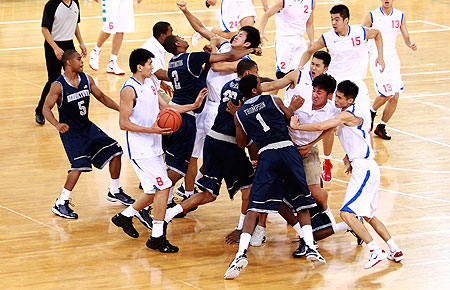
Players from American Georgetown University men's basketball team and China's Bayi men's basketball team fight during a basketball friendly game at the Beijing Olympic Basketball Arena August 18, 2011 (Photo: China Daily / Reuters)
When Chinese Vice President Xi Jinping welcomed his American counterpart Joe Biden to Beijing’s Great Hall of the People on his first visit to China in a decade, their remarks were distinctly parallel and overwhelmingly positive. “It is the joint desire of the people of China and the United States and elsewhere in the world to stay in constant cooperation,” said Xi. Biden responded in much the same language. “Our commitment to establishing a close and serious relationship … is of the utmost importance to my country,” he told the man most likely to take over next year when President Hu Jintao steps down.
It was a moment of accord between two powers that are both deeply reliant and wary of one another. The U.S. is China’s top trading partner, while China is the largest foreign holder of U.S. debt. China has been exasperated by the debt ceiling debate, Standard & Poor’s downgrade of the U.S. credit rating and the prospect of further American arms sales to Taiwan. The U.S. still has complaints about the value of China’s currency and its growing military might. While those differences are most certainly being discussed behind closed doors during Biden’s 4-day China visit, the public talk has been of the need for cooperation and common ground.
But Biden had not even finished his comments Thursday when that veneer of harmony began to falter.
This is how the pool reporter, Michael Memoli of the Tribune’s Washington Bureau, described the scene:
As Biden was wrapping up, your pooler was in a shoving match with a larger Chinese official attempting to clear press from the room. Officials said Biden was going on too long, though he at that point had not spoken for more than 5-6 minutes, including the consecutive translation.
Despite occasionally successful efforts at holding our ground, poolers were continually pushed further toward the exit. Once it was clear that Biden was concluding we departed.
A number of fellow reporters and staff said they hadn’t seen quite that level of aggressive force attempting to remove us from such an event.
Later Biden went for lunch at a restaurant that serves stewed liver and other Beijing specialties. He pretended to join a family at their table, showed off his granddaughter Naomi who is traveling with him and joked that his meetings with Xi went well, but it’s harder to order lunch. It was retail politicking at its finest, and surely the vice president hoped the sight of him having friendly chats with Beijingers at lunch would be the defining image of the day.
It was not. By evening, Biden’s lunch was replaced by a far less harmonious image of Sino-American relations. An exhibition game in Beijing between Georgetown University’s men’s basketball team and the Bayi Rockets, a team that represents China’s People’s Liberation Army, erupted in an ugly brawl. The Washington Post describes the scene like this:
There were an estimated half-dozen individual altercations on the court, and eventually some Chinese onlookers joined the fracas, including one wielding a stanchion. As the brawl spilled beyond the baseline, an unidentified Bayi player pushed Georgetown’s Aaron Bowen through a partition to the ground before repeatedly punching the sophomore guard while sitting on his chest.
Georgetown senior center Henry Sims had a chair tossed at him by an unidentified person, and freshman forward Moses Ayegba, who was wearing a brace on his right leg, limped onto the court with a chair in his right hand. According to Georgetown officials, Ayegba had been struck, prompting him to grab a chair in self-defense.
As any NBA fan knows, fights are a part of the game. But this wasn’t an average game. Biden wasn’t there, but the night before he had watched the Hoyas defeat a team from Shanxi province. The mix of sport and international relations had prompted suggestions of a return of “ping-pong diplomacy,” the 1970s table tennis exchanges that helped ease Sino-U.S. tensions. It’s unclear what exactly touched off the fight, though presumably it wasn’t a discussion of the U.S. credit rating. Still, two groups of young men coming to blows on a basketball court managed to undermine the facade of cooperation their nation’s leaders sought to portray just hours before.
More on Time.com: Watch the brawl between Georgetown and the Bayi Rockets.