


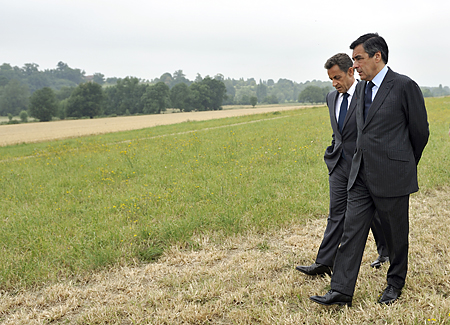
French President Nicolas Sarkozy (L) and Prime minister Francois Fillon walk in a field as they visit a chicken raise farm on June 28, 2011 in Sable-sur-Sarthe. (Photo Eric Feferberg / AFP / Getty Images)
As polls have persistently shown both leading candidates in France’s Socialist Party presidential primary beating conservative incumbent Nicolas Sarkozy in mock elections over the months, Elysée advisers have confidently predicted voters will again swing behind their champion en masse once he starts campaigning on his bilan—or, roughly, accomplishments in office. The idea being that even though Sarkozy’s approval and popularity numbers are awful, he’s destined to rise in voter esteem once he starts comparing his presidential record against leftist rivals who have none.
The plan just may work if Sarkozy runs on his bilan in Libya, because it’s increasingly looking like there’ll be nothing left of his rapidly vanishing policy reforms to talk up by the time election day rolls around. Austerity measures announced by his government Wednesday gave a coup de grace to what remained of Sarkozy’s earlier innovations, and even involved an about-face of the very spirit those now-culled policies embodied.
The austerity measures announced Wednesday by Prime Minister François Fillon in large part involved rolling back of some of the last Sarkozy reforms that hadn’t been over-turned or quietly ditched before as inefficient, ill-conceived, or financially untenable in an increasingly tight economy. Among those reclaimed gifts from the government was a series of tax cuts and ceilings Sarkozy passed just months after his election—a marquee let-people-keep-their-money move that was almost purely ideologically founded, widely denounced as benefiting France’s wealthiest people, and responsible for generating an additional sea of red ink in national accounts. Indeed, even Fillon eventually indicated his boss’s 2007 package of tax slashes and limits on affluent households explained why “the state’s coffers are empty” as that year closed out.
They’re still empty—and clanging even emptier in 2007 with France running a budget deficit running 5.7% of GNP that’s only set to drop to 4.6% in 2012. Worse still, in making his speech, Fillon was forced to lower risibly optimistic government growth forecasts of 2% this year and 2.25% in 2012 to a 1.75% level most economist still call fanciful. And all that comes at a time as markets have extended their debt concerns from Greece, Spain, and Italy towards France—forcing Paris to make moves to address its escalating debt problem. To do so, Fillon unveiled spending cuts of nearly $16 billion over the next 18 months in the hopes that might help calm jittery market nerves—and preserve France AAA credit rating.
But if people across France will feel the pain of that response, they’ll share that discomfort with others not used to suffering as much—starting with Sarkozy and his bilan. Since many of Sarkozy’s 2007 showcase tax measures were already been earmarked for de facto gutting earlier this year, Fillon had to unplug most of his boss’s remaining fiscal reforms—and betray the very ideological spirit they embodied to boot. First among those, a 3% tax on France’s wealthiest households–a contribution in crisis Fillon called “exceptional” to convey how distasteful and temporary his government considers the move. That hit will affect annual incomes of $700,000 and higher, and raise an expected $280 million in new revenues. However, like so many other taxes introduced in France over the pasts 30 years on provisional grounds, that new levy risks becoming permanent with time out of financial necessity and political convenience.
The ideological and policy climb-down doesn’t end there, however. Also slashed are government subsidies of employer charges tied to over-time work—a handout to companies that was intended to encourage them and employees to embrace Sarkozy’s campaign exhortation for French workers to “earn more by working more”. Despite the almost Soviet-style repetition of that phrase during the first half of his presidency, the response to that call was never as great as Sarkozy expected, which is presumably one reason his government has decided to pull most of its financial incentives to promote it. As a policy roll back, it’s tantamount to U.S. President Barack Obama passing a “No, We Can’t” bill.
Also in the austerity mix is a tightening of rules allowing companies to reduce taxes they pay—a pirouette coming just two years after Sarkozy simply eradicated a long-standing French corporate tax, and placed the onus on regional governments to come up with the shortfall in funding. A vast array of fiscal “niches” allowing various income—on rent collected, for example—to enjoy lower tax rates will also go through the grinder.
Given the current pressure on governments to reassure markets concerned about the euro zone’s debt problem, it’s hard to fault any European capital looking for ways to cut spending, trim debt, and calm the crisis. Still, for a leader with an almost adolescent need to always be right and never admit to giving in, it’s incredible to see how the new austerity measures—especially in the wake of earlier reforms similarly being un-done—leave so little behind of any active economic bilan Sarkozy might have boasted at one time. Still the new there is something in the package he can point to while on the campaign trail: a 6% tax hike on alcohol and tobacco products, meaning Sarkozy can run as the healthy levy candidate. Beyond that, however, he’d better talk up his achievements in Libya if his re-election bid is to be fueled by pointing to his lasting achievements in office.