


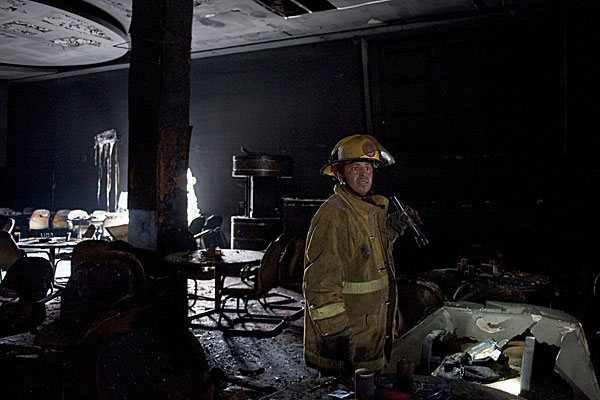
A firefighter searches for bodies inside the burnt down Casino Royale, in Monterrey, Mexico, on August 26, 2011. (Ronaldo Schemidt-AFP-Getty images)
It’s getting harder and harder to remember the Monterrey, Mexico, I first visited in 1990. Not because I’m 21 years older, but because the city now seems frighteningly darker. Monterrey in those days, on the eve of NAFTA, wasn’t just Mexico’s new business capital. It was the country’s window to the developed world – a desert beacon, symbolized by the towering Faro de Comercio, or Lighthouse of Commerce, thrusting lasers into the surrounding sierras. Back south, Mexico City was the jaded, smoggy, authoritarian past; industrialized Monterrey and its three million entrepreneurial residents were the northern, modern, democracy-minded future.
Which is why it’s so difficult to watch what’s happened to the place over the past five years – most hellishly manifested by the massacre of 52 people yesterday, Aug. 25, in a Monterrey casino set ablaze by gangsters. As my colleague Ioan Grillo points out in his story today, the horrific scene was seemingly the only way Monterrey’s criminals could top their most recent exhibition: hanging live victims from bridges and overpasses and repeatedly shooting them as if they were macabre piñatas. Monterrey, you’ll recall, was where a kindergarten teacher became a hero in May when a YouTube video showed her calming her kids as hit men executed five people with assault rifles outside her school.
(See the TIME cover story “Day of the Dead”)
The lighthouse has dimmed, and it’s happened stunningly fast. In 2005, the global consulting firm Mercer ranked Monterrey as Latin America’s safest city. But in 2006 it began falling to los narcos – the drug-cartel mafiosi responsible for 40,000 murders in Mexico since their violence began spiraling out of control that year. Drawn to Monterrey’s gleaming wealth and its proximity to the trafficking corridors of the border, they announced themselves by gunning down the top criminal investigator of Nuevo León state (of which Monterrey is the capital) on the steps of a church, in front of his young daughter. Then they started building garish mansions in Monterrey suburbs like San Pedro, practically next door to the city’s business nobility. Ever since, the local murder rate has leapt to 27 per 100,000 residents last year from fewer than five per 100,000 in 2005. Extortion (perhaps the motive for the casino arson massacre) and kidnapping are rampant.
How could Mexico’s city of the future have been beaten backward like this? For the same reason the narco-insurgency has spread through the rest of the country: America’s insatiable appetite for drugs coupled with Mexico’s incorrigible failure to build modern police and judicial institutions. But it’s the latter factor that makes Monterrey’s current trauma doubly disappointing. Precisely because it was Mexico’s modern showcase, we expected Monterrey to be the nation’s security exception. Instead, the city’s elite – the Garzas and Sadas, the cement moguls and glass barons – proved themselves no more capable than the rest of Mexico when it came to making the rule of law a civic priority.
There are few journalists in the Americas I respect more than Ramón Alberto Garza, who 21 years ago was the editor of the Monterrey daily El Norte – then one of the few voices independent of the dictatorial Institutional Revolutionary Party (PRI), which was finally toppled in 2000 – and today heads the city’s respected online newsmagazine Reporte Indigo. In 1990, as then Mexican President Carlos Salinas hosted then U.S. President George H.W. Bush for a pre-NAFTA summit in Monterrey, Garza told me, “Salinas wants to use Monterrey to show Americans that in Mexico they can deal with First World people, not just a bunch of hands but a bunch of brains, too.” In 2007, however, amid the vicious escalation of the Monterrey turf war between the Sinaloa Cartel, Mexico’s largest drug mafia, and the Zetas, its most bloodthirsty, he lamented, “No one wants to admit that we’ve become a dormitory for drug lords.”
Monterrey’s leaders insist its business and industry still thrive despite the violence, that it keeps creating jobs and raking in foreign investment. Some 1,200 U.S. businesses have major operations in Monterrey – then again, given the sweet deals American companies enjoy along the Mexican side of the border, it might take the siege of Stalingrad to drive them out. But even the gringos are getting worried. Farm-machinery maker Caterpillar last fall ordered executives with children to leave Monterrey; the U.S. consulate there issued a similar directive. This year, the mayhem prompted European helicopter maker Eurocopter to decide against Monterrey as the site for a $500 million plant.
The situation of course hasn’t reached the depths of Juárez, the narco-beleaguered border city that today has the world’s highest murder rate – and where the commercial tax base has shrunk 40% since 2008, according to Arturo Chacón, a social science professor at the Monterrey Technological Institute’s Juárez campus. But if regiomontanos, as Monterrey residents are known, don’t solve their narco-terror soon, they risk similar economic erosion down the road.
To their credit, Monterrey and its suburbs have in fact started pursuing credible police reforms toward that end. But those can take years, if not a generation, to bear fruit. Regiomontanos should have begun that effort a generation ago – when we were all still impressed by the lighthouse lasers.