


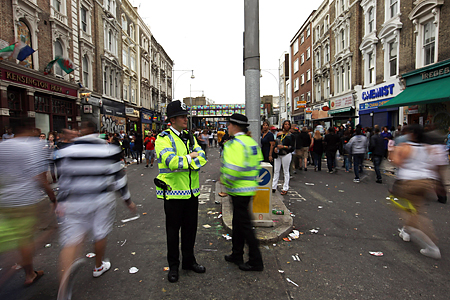
Police officers monitor the crowds at the Notting Hill Carnival on August 28, 2011 in London, England. (Photo: Oli Scarff / Getty Images)
Less than a month after riots tore across London, British authorities were understandably nervous to host Europe’s biggest street fair, the Notting Hill Carnival, which draws an estimated 1 million people annually.
The carnival celebrates Caribbean culture, featuring steel bands, floats, and a Mardi Gras atmosphere. It’s also been a source of trouble for police in years past, with a history of violence and gang activity. Not to mention that the inciting trigger for the Tottenham riots was a protest of the police shooting of a man of Jamaican descent.
Nevertheless, London Mayor Boris Johnson called for the festival to continue. “It’s right that the carnival goes ahead so we can show the world that the overwhelming majority of London’s people are decent, law-abiding citizens who respect the law, love their city and want to celebrate our vibrant, diverse and historical culture,” he said. “Let the true spirit of London shine through.”
Shine through, with a lot of precautions and 6,500 extra police on hand. Carnival organizers agreed to end festivities 90 minutes early on both days – the festival runs two days, a kids day on Sunday and the main event on Monday, which is a bank holiday in England. Police preemptively arrested 40 people to counter any potential disorder and have been carefully monitoring social media for riot plots.
More stores than normal – and even a few private homes — blocked out their windows. In a long standing tradition, festival goers delight in plastering the boards with graffiti. Fewer street hawkers and musicians showed up this year; likewise thinner crowds than in years past showed up. There were virtually no lines for food or toilets. “It’s very quiet this year, I think due to violence,” says a hat hawker who would only identify himself as Jeff. “Compared to the last four or five years, it’s very, very quiet. I’ll be surprised if I make my rent.”
Some people may have also been put off by the rain – around 1pm on Sunday there was an unexpected and intense downpour. Though, London’s unpredictable weather has never deterred people in the past, says a man who would only identify himself as Roger. Roger, who totted his two-year-old son on his shoulders, happily tooting a horn, has been coming to the Notting Hill Carnival since 1988. “So far seems a little bit quieter. More police obviously,” he says. “It’s maybe 5-10% less crowded.”
The only stores that remain open on Portobello Road are the pubs. For this one weekend a year, giant floats and showgirls dancing in glittery bikinis replace the upscale street market made famous by Hugh Grant and Julia Roberts in movie Notting Hill. The pubs and bars pushed to keep the carnival open. “It brings in too much money, we couldn’t close carnival weekend,” says Juliet Graziano, a young bartender in a Red Strip t-shirt at The Ground Floor. “Though, it’s not as busy as last year. That’s probably to do with the riots.”
Despite the subdued atmosphere, tens of thousands of people still flocked to the festival on Sunday. They ate jerk chicken and grilled corn and danced in the streets. The occasional waft of ganga perfumed the air. The preparations clearly helped: only 53 people were arrested on Sunday, down from 68 the same day last year. Though still on tenterhooks, London, it seems, is returning to normal.