


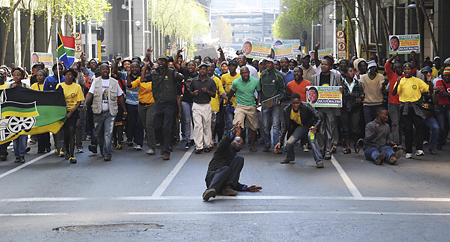
African National Congress Youth League (ANCYL) supporters march to ANC headquarters in downtown Johannesburg, Tuesday, Aug. 30, 2011 as they protest at the start of a disciplinary hearing against their leader Julius Malema. (Photo: AP)
If ever proof was needed that competition – and its political manifestation, democracy – is as humanly innate as Darwin claimed, it is in the constant, sometimes violent challenges that confront one-party states. The Arab world is experiencing the ultimate expression of the universal opposition to a life without choice and the desire for political freedom: revolution across the Middle East. Another, more common manifestation is the constant turmoil that rages inside what are meant to be monolithic ruling parties. When they are not tracking protests against the state, for instance, China watchers are forever reading the runes of Asia’s future through the jossling of reformers and conservatives among the Communist Party. In Africa, home to more one-party states than any other continent, two giants are evolving because of dramatic changes at the top of the ruling party. In Nigeria, Jonathan Goodluck’s ascension to the leadership of the People’s Democratic Party, and thereby the Presidency, signals reforms in economics if not politics. Sudan is heading in the other direction, turning more militant and Islamist now the generals have subordinated President Omar al-Bashir in a coup inside the National Congress Party.
To that list, add South Africa. In theory and in constitution, South Africa has been a democracy since the end of apartheid in 1994. In practice its elections and politics are so dominated by the party that overthrew apartheid under Nelson Mandela, the African National Congress (ANC), that South Africa is, excepting a few opposition local authorities, effectively a one-party state. Evidence of how unnatural and frustrating a form that is for human affairs comes in the vicious infighting which has raged inside the ANC since Mandela stepped down as President in 1998. The latest episode in these factional wars reaches its latest climax this week at ANC headquarters in Johannesburg. In internal party disciplinary hearings, the party elders, represented by President Jacob Zuma, 69, and veterans of the struggle against apartheid, are attempting to crush its youngters, represented by the ANC Youth League and its loud-mouthed 30-year-old leader, Julius Malema. Malema and five Youth League colleagues could even be expelled from the ANC. Make no mistake that this is an event of importance equal to an election in a genuinely competitive democracy: whoever wins will be the future leader of South Africa.
But closed hearings inside a ruling party are a poor susbstitute for open, participatory democracy. Not least because at stake are not two different visions of South Africa but – like the rivalry between President Dmitry Medvedev and Prime Minister Vladimir Putin in Russia – merely two different views on who should run it. Just two years ago, Zuma and Malema were allies who had successfully plotted to unseat Mandela’s successor as President, Thabo Mbeki. (Back then, Malema said he would “kill” for Zuma.) Since, Malema has outshone his putative mentor by the simple tactic of courting outrage wherever he can. Among his wilder statements have been accusations that the opposition leader is “suffering from satanism”, that a BBC correspondent is a “bloody agent” and Zimbabwe’s broken economy and moribund farms are an example of agricultural genius. But if Malema’s rhetoric is outlandish, his politiking has been shrewd: the opposition, the media and even Zuma all allowed themselves to be swept up in the storm that greeted each of Malema’s new affronts, effectively making him the central political figure in South Africa.
Zuma seems, finally, to have heard enough from his former protege – not least because though he once said he only wanted to serve one term, the President’s sights are now set on a second. The opportunity for this week’s disciplinary hearings – the second Malema has faced – was provided by the Youth League leader’s latest outburst, a call for the overthrow of a friendly government in neighboring Botswana which Malema claimed was too Western and too capitalist.
If that – a genuine difference in ideology – was indeed at the heart of the ANC’s troubles, and South Africa a genuine multi-party democracy, the ANC might split. That this is actually a pure power struggle inside a one-party state was never more apparent than on Tuesday morning when, as Malema’s hearing began, his supporters attempted to take over the ANC’s headquarters by force. Running riot through central Johannesburg, they set garbage bins alight and pelted police and journalists with rocks as they tried to tear down barricades around Luthuli House, the ANC building. The police responded with rubber bullets and water cannons. Until the day the normal, human aspirations of South Africans – good and bad – are released into the wide open space of meaningful democracy, it can expect more of the same.