


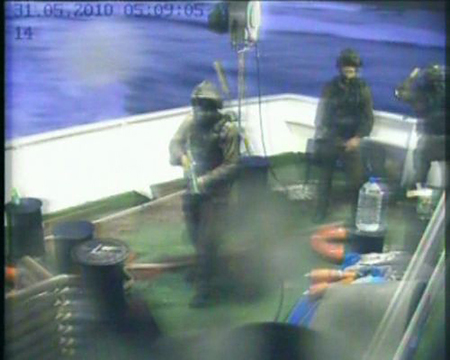
A television grab made from the Turkish TV channel Cihan News Agency shows Israeli Navy troops storming the "Mavi Marmara" Turkish aid boat, carrying aid to the Gaza Strip, on May 30, 2010. (Photo: AFP / Getty Images)
Well that ended well, didn’t it?
Fifteen months after Israeli commandos clashed with Turkish activists on the high seas, leaving nine civilians dead and Israel’s public image in further tatters, the United Nations report on what was popularly known as the Flotilla Fiasco has emerged. The Palmer Report, named for the former New Zealand premiere who chaired the fact-gathering panel, turns out to be true to the spirit of the affair, a diplomatic effort that has both countries clawing at each other’s throat.
In the immediate wake of the report, Turkey said on Friday that it was downgrading both diplomatic and military ties and was expelling the Israeli ambassador because Israel’s refuses to apologize for the raid. Turkish Foreign Minister Ahmet Davutoglu said Ankara would lower its diplomatic representation in Israel to the level of second secretary (one of the lowest diplomatic ranks). Ambassador Gabby Levy was ordered to leave Turkey by next Wednesday. According to Reuters, Levy is currently already in Israel and had canceled plans to return to Turkey.
There’s something for everyone in the 105 pages. Israel gets to hear its naval blockade of Gaza called legal under international law — a narrow point that was not much in question, but a point Israel is delighted to see made. (“U.N. panel backs blockade of Gaza” was the play headline in Friday’s International Herald Tribune.) The actual issue, for those feeling sympathy for the 1.5 million Palestinians trapped in the Gaza Strip, was not the military blockade of the seacoast but the “siege” of Gaza as a whole, at least on the three sides of the enclave that Israel controls. After Hamas took over the strip and kidnapped an Israeli soldier, in 2006, Israel closed down a wide array of imports to Gaza, a collective punishment intended not to starve Gazans but to “put them on a diet,” as an aide to then-prime minister Ehud Olmert famously put it. The Turkish ferry Mavi Marmara was the flagship for an “humanitarian aid flotilla” that aimed to draw attention to the siege by breaking it. In the outcry that followed the botched attempt to board the vessel, Israel agreed to loosened the import strictures, conceding what one senior minister admitted was a mistaken policy from the start.
“Stopping ships for reasons of security is legal — the civilian closure of Gaza is not,” said Gisha, a nonprofit that advocates for freedom of movement in and out of Gaza, and especially between Gaza and the West Bank. “The Palmer Commission did not review Israel’s overall closure of the Gaza Strip, still in place today. For it to conform to the principles of international law, Israel must remove the sweeping restrictions on export of goods, movement of people between Gaza and the West Bank and entrance of construction materials.”
For its part, Turkey embraced the UN finding that Israel’s elite naval commandos used “excessive and unreasonable” force on board the ship, even though some 40 of the hundreds of passengers were clearly organized and violently resisted being boarded. The UN also faulted Israel for rough treatment of the other passengers, some of whom had belongings stolen after being taken into custody. The report’s call for “an appropriate statement of regret” from Israel was exactly what Ankara and Jerusalem tried to negotiate for weeks this summer, along with compensation for families of the nine dead. As the talks rolled along, delaying the release of the UN report, compromise began to seem almost likely, especially after the Turkish government, which had encouraged the first flotilla, intervened to help prevent a reprise this year. Shared interests in Syria, boiling all summer, also seemed to be bringing the governments together, with eager encouragement from Washington. But in the end the government of prime minister Benjamin Netanyahu could not bring itself to use the word “apologize.”
“Honor is a strategic asset,” said vice prime minister Moshe Ya’alon, explaining the impasse. And so the two countries — unusually close allies just three or four years ago — are where they found themselves last summer: Very much at sea.