


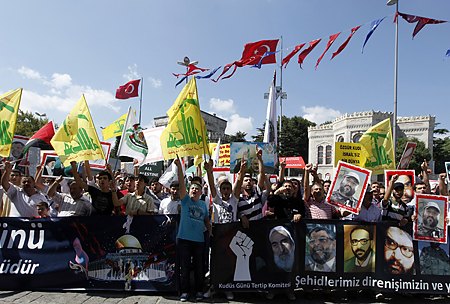
Turkish demonstrators shout anti-U.S. and anti-Israel slogans during the al-Quds day demonstration in Istanbul, August 26, 2011. (Photo: Osman Orsal / Reuters)
Israel’s fallout with long-time ally Turkey is no isolated spat that will be repaired any time soon; it’s a dramatic illustration that no amount of U.S. backing can prevent the growing international isolation resulting from Israel’s handling of the Palestinian issue. Indeed, the unconditional nature of Washington’s backing may, in fact, have become dysfunctional to Israel’s diplomatic standing: A U.S. domestic political climate in which challenging Israel on anything is about as wise as threatening to cut medicare payments leaves Washington unable to restrain the most right-wing government in Israeli history from its most self-destructive urges, while economic changes and the radical policies adopted by the United States in the decade since 9/11 have left Washington’s influence in the Middle East at its weakest since World War II.
The trigger for Turkey expelling Israel’s ambassador, cutting defense ties and vowing to wage a diplomatic campaign against the blockade of Gaza and in support of the Palestinian move for recognition of statehood at the United Nations was the Netanyahu government’s refusal to apologize for the killing of nine Turkish citizens and a Turkish American in last year’s raid on the Gaza flotilla. The Obama Administration had tried to broker a rapprochement involving some form of Israeli apology, which Prime Minister Benjamin Netanyahu had reportedly been inclined to accept but his ultranationalist foreign minister and key coalition partner (as well as rival) Avidgor Lieberman refused to countenance it.
The breakdown, however, is about a lot more than an apology: The flotilla itself, after all, had sailed in direct challenge to the Gaza blockade, with the support of the Turkish government — an expression of the fact that Ankara was no longer willing to follow its NATO allies, under U.S. leadership, in turning a blind eye to the plight of the beleaguered Palestinians. Israeli leaders and their most enthusiastic boosters in Washington like to paint this as a sign that Turkey had “gone over” to the region’s Iranian-led “resistance” camp, but despite the ruling AK Party’s roots in moderate political Islam and its insistence on a political solution to the nuclear standoff with Iran, Turkey is in fact a regional rival for influence with Tehran. Ankara’s stance on the Palestinians, like its refusal to support or enable the Bush Administration’s invasion of Iraq and its stance on the Iran nuclear issue or its break with the Syrian regime of President Bashar al-Assad, is based on its own reading of what’s good for the region — which is quite different from Washington’s — and on Turkish public opinion. And, as if to underscore the fact that its break with Israel doesn’t threaten its commitment to NATO, Turkey announced last week that it had agreed to host radar installations for a NATO missile defense system targeting Iran.
Turkey’s actions also reflect a growing international impatience with and loss of faith in Washington’s handling of the Israeli-Palestinian conflict. Israel is worried, with good reason, that Egypt — whose foreign policy has been made more responsive to public opinion by the overthrow of the Israel-friendly U.S.-backed President Hosni Mubarak last February — may follow the Turkish example.
And the fact that a Palestinian leadership that has essentially mortgaged its political fate to the U.S. for the past two decades is now proceeding, over Washington’s objections, to seek U.N. recognition of a state based on the 1967 — and will likely win the backing of the overwhelming majority of member states — is testimony to the collapse of a tacit acceptance by U.S. allies since the Oslo Accords that the Israeli-Palestinian file would remain Washington’s exclusive preserve.
President Barack Obama Administration’s repeated humiliation at the hands of Prime Minister Benjamin Netanyahu whenever he tried to put his foot down on over Israeli behavior so at odds with the international consensus that it threatened Israel’s long-term standing graphically demonstrated to the Arab world, and even many Europeans, that the U.S. was simply incapable of delivering on its promise of a fair deal for the Palestinians. Obama, for his part, has simply given up trying, and his Israeli-Palestinian efforts today appear to be restricted to trying to bully and entice the Palestinians into staying away from the U.N. and instead resume U.S.-mediated talks with Israel. But the “peace process” to which all U.S. allies were expected to defer is a butt-naked emperor, and Turkey’s actions over the past week offer a sharp reminder that there aren’t many left who’re willing to ooh and aah over its couture.
It would be understatement to say that Israel has grown complacent behind the diplomatic shield provided by the U.S. Its political leadership has drifted steadily to the right and away from the international consensus on the terms of a two-state solution over the past decade, apparently heedless of the fact that its diplomatic gains in the years following the Oslo Accords were contingent on its intention to move towards that consensus.
The Bush Administration broke the mold, treating the Israeli-Palestinian issue first and foremost as a problem of terrorism, allowing it to put a political settlement to the conflict on the back burner — or in formaldehyde, as Dov Weissglass, then an aide to Prime Minister Ariel Sharon put it. Israel could simply go through the motions of an occasional photo opportunity with President Mahmoud Abbas, and White House would continue to mouth the catechisms of the Oslo era, and that would be that. The Arabs and Europeans were horrified, but with the U.S. bull charging around the Middle East china shop, none was about to publicly challenge it.
In early 2007, in an op ed in the Israeli daily Haaretz, I warned that Israel was jeopardizing its own long-term position in the region by tying its own fate to that of the Bush Administration’s reckless and misguided effort to remake the Middle East through military force — efforts which, by then, were clearly failing:
“Betting Israel’s security on the ability of the Bush crowd to transform the strategic landscape in the Middle East is rather like leaving a party in the backseat of an SUV whose driver is cradling a bottle of tequila and slurring his words as he rebuffs offers by more sober friends to take the wheel… America’s overwhelming military advantages have failed to tip the region’s political balance in its favor; on the contrary, resorting to military force over the past four years has actually been accompanied by a precipitous decline in America’s ability to influence events in the region and beyond, much less impose its will.”
Unconditional U.S. support for Israel regardless of how its actions affected the prospects for peace with the Palestinians has, predictably, diminished those prospects. Why, after all, would Israel take the political risks required to settle with the Palestinians if maintaining the status quo has no downside? And the practice in recent years has been that the U.S. will run diplomatic interference for Israel regardless of the circumstances, even vetoing U.N. Security Council resolutions that accord with Washington’s own policy.
But the U.S. ability to shield Israel from the consequences of its actions has dimmed with Washington’s own declining influence over long-time allies. It will take something a lot more substantial than the umpteenth rerun of the rituals of a moribund peace process for Washington to reverse Israel’s isolation, but the shift in Israel’s domestic politics — behind the U.S. diplomatic shield — over the past decade makes it less likely than ever that Israel will willingly agree to a two-state solution based on the international consensus. Perhaps ironically, though, the actions by Turkey and others could help any future U.S. effort to press the Israelis towards a credible deal — by allowing Washington to point to visible negative consequences for Israel in maintaining the status quo.