


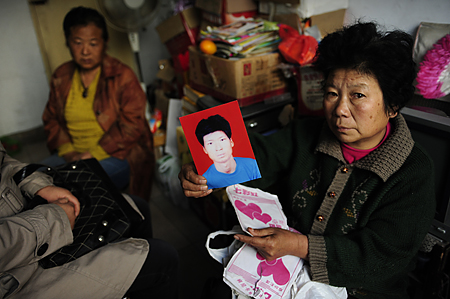
Hu Xiaojiao shows a photo of her missing son, whom she says in in forced labour in a Chinese brick kiln, whilst talking to AFP, November 7, 2009, in a room in the city of Zhengzhou. (Photo: Peter Parks / AFP / Getty Images)
Four years after China’s last major slave labor scandal, a group of disabled men has been freed from a brick kiln in the central province of Henan after an investigation by an undercover television reporter. Some of the men had been forced to work for years without pay, enduring beatings and poor food and living conditions, the state-run China Daily reported. The abuses were uncovered by Cui Songwang, a reporter for a Zhengzhou television station, who hung around a train station posing as a disabled man for two days until he was kidnapped and sold to a kiln manager for 500 yuan (about $75). Cui said he was forced to work for three hours, beaten and deprived of water before he managed to escape and report the case to police. (Chinese report here.)
The abuses recall another slave scandal, this time centered at brick kilns in Shanxi, also involving disabled men kidnapped from railroad stations in Henan who were also sold on for 500 yuan. That case was uncovered in 2007, after parents of the missing took their pleas to the Internet. Looking at my colleague’s blog post from then, it’s striking how little has changed. After the 2007 case grabbed the attention of the Chinese leadership, a massive investigation was launched, and hundreds of people were found to be doing forced labor in brick kilns, coal mines and foundries.
Despite the attention those cases received, the problem has persisted, exacerbated by corruption, lax law enforcement and a shortage of services for disabled people that leaves many to get by on their own. The China Labour Bulletin, a Hong Kong-based NGO, points out that in 2008 a forced labor scandal was covered in the manufacturing hub of Dongguan, where hundreds of teenagers from the interior were forced to work for little or no pay. In December a newspaper in China’s northwestern Xinjiang region uncovered a factory that was holding developmentally disabled slave workers who had been sold by a shelter in Sichuan. The couple who ran the shelter were accused of earning $450,000 off the sales of more than 130 disabled people to mines, kilns and factories.
After the 2007 case there were disturbing reports (detailed again here by CLB) that some of the freed slaves never made it home, that their families couldn’t be found, that they fled protective custody, or in one case, a 14-year-old boy was sold back to another brickyard by labor officials charged with caring for him, according to a Henan Television story. Once again officials are reporting difficulties identifying some of the recently freed slave laborers. One hopes that this time they all find a safe home.