


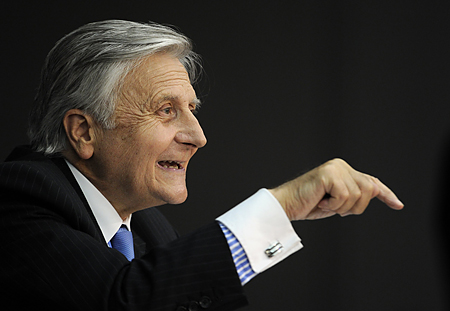
Jean-Claude Trichet, president of the European Central Bank (ECB), gestures during a press conference on September 8, 2011 in Frankfurt, Germany. (Photo: Boris Roessler / AFP / Getty Images)
There are several reasons one might have chosen to attend the Sept. 8 press conference at the Frankfurt headquarters of the European Central Bank: to find out what the ECB had decided on interest rates (the bank held its benchmark interest rate at 1.5%) or how it had revised its growth forecasts (down to 1.6% from 1.9% in 2011 and from 1.7% to 1.3% in 2012). If you were peckish and embarking on the kind of austerity drive richer eurozone nations have prescribed to profligate countries such as Greece and Italy, you may have been tempted to stock up from the generous spread of hot and cold food on offer on offer to attendees (prawn and egg sandwiches, meatballs). But it’s unlikely that anyone turned up expecting a world-class rant. Nevertheless, that’s what Jean-Claude Trichet, the outgoing president of the ECB, delivered after a German journalist quoted criticisms of the ECB expressed earlier the same day during a German parliamentary debate on expanding the eurozone bailout mechanism. Sigmar Gabriel, who leads Germany’s opposition Social Democrats, had described the ECB as mutating from “anchor of stability to a European bad bank.” The quote provoked Trichet into a passionate defense of the ECB and, by implication, his own stewardship during “the worst crisis since World War II.” Trichet insisted:
We have delivered price stability over the first 12 years and 13 years of the euro—impeccably, impeccably! I would like very much to hear the congratulations for an institution which has delivered price stability in Germany…better than what has ever been obtained in this country over the last 50 years.
The ECB may have fulfilled the letter of its mandate but with the euro in crisis as more affluent members of the single currency contemplate having to keep bailing out poorer members, the bank’s range of tools look woefully inadequate. As my colleague Roya Wolverson explained, the logic of a European fiscal union may be the only way to prevent the fracturing of the single currency. Yet curing European ills by prescribing more Europe doesn’t go down well with everyone. Near the base of the ECB building, there’s a stand selling tourist paraphernalia. The owner says he’s sick of working hard so that “Greeks can sit in cafes and drink coffee with brandy all day.” Business is brisk and Germany could easily go it alone, he says.
A unexpectedly sharp contraction in exports, by 1.8% in July, revealed on the same day as the ECB press conference and the parliamentary debate on the eurozone bailouts underscores one reason that German political leaders are unlikely to act on such sentiments, even if they’re not averse to a little Greek-bashing themselves. The German economy is export-driven; the nation’s prosperity relies on selling its goods and services beyond its borders. Bad-tempered exchanges in the parliamentary debate masked a growing consensus among the parties with all but the hard-left party die Linke agreeing with the principle of offering help to other eurozone countries. Germany’s constitutional court on Sept. 7 dismissed a challenge to the first round of bailouts but ruled that future subventions must be approved by the parliamentary budget committee. This adds a new, and potentially time-consuming hurdle, to a process that has already proved too cumbersome to pacify febrile markets.
Perhaps it was the prospect of those bottom-numbing, brain-draining committee hearings that provoked German Chancellor Angela Merkel into a declaration almost as passionate as Trichet’s—and at least as surprisingly so. Like the central banker, she rarely betrays emotion, and on the fate of the single currency she has attracted criticism for failing to articulate its importance with sufficient force. Her statement to the Bundestag was unequivocal. “The euro is much, much more than a currency,” she said. “The euro is the guarantee of a united Europe. If the euro fails, then Europe fails.”
Catherine Mayer is London Bureau Chief at TIME. Find her on Twitter at @Catherine_Mayer or on Facebook at Facebook/Amortality-the-Pleasures-and-Perils-of-Living-Agelessly . You can also continue the discussion on TIME’s Facebook page and on Twitter at @TIME .