


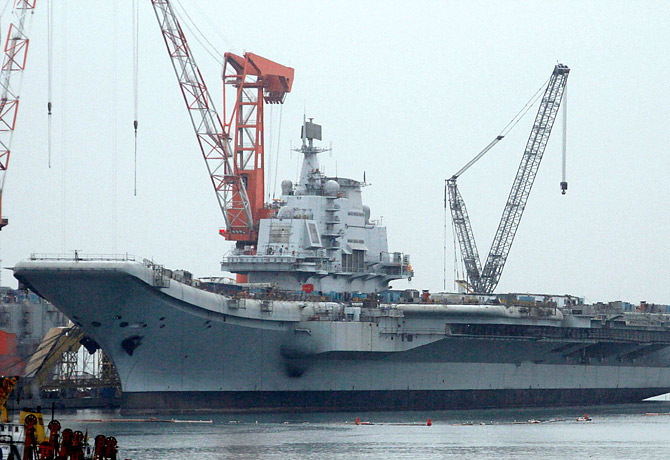
A vessel reported to be the Ukrainian-made aircraft carrier Varyag, which China bought in the 1990s, is seen at a port in Dalian, Liaoning province, April 17, 2011. (Photo: Reuters)
As the commentaries, retrospectives and meditations pile up ten years after 9/11, expect quite a few in their closing paragraphs to look toward the next grand geo-political challenge facing the U.S. A decade of costly adventurism in the Middle East and Afghanistan, many will argue, distracted U.S. policy making from the new realities of Asia, where some of the world’s main economies and rising powers are shaping the future decades of the 21st century.
The bogeyman here is not an ideology or some shadowy terrorist threat, but, to be blunt, China. Beijing’s rise as an economic and military power raises understandable concerns. The modernization of its navy and army seem calculated to directly challenge the preeminence of American power. As an authoritarian state, China has shown a penchant for a cold-blooded foreign policy, happy to support troublesome regimes from Khartoum to Pyongyang. A raft of pundits have already issued grim warnings about the future of the global liberal, democratic order — one which emerged during the 20th century’s Pax Americana — as it gets pressured by the new imperatives of a Chinese hegemon.
Tapping into this sense of alarm, an essay published last week in the National Review by Michael Auslin, the resident East Asia scholar at the right-of-center American Enterprise Institute, offers up a vision for American strategy in the Pacific. Though Auslin claims his proposal is more “pro-Asia” than it is “anti-China,” it’s hard to see how the two in his formulation are all that different.
Auslin’s essay — entitled “Build, Hold and Clear: An American Strategy for Asia” — is a re-invention of the U.S.’s “counter-insurgency” doctrine invoked in Iraq and Afghanistan of “clear, hold and build,” now applied across the wide tableau of the Asia-Pacific. Given the profound doubts hanging over U.S. operations in those two war-blighted countries, questions ought to immediately arise. Auslin shrugs off any concerns of U.S. decline or failure, and calls for policymakers to focus on “the next American era today.” This involves, ostensibly, reasserting U.S. interests across Asia by “building a larger community” of like-minded allies and confronting China more directly. Auslin writes:
We must have a clear diplomatic line that does not confuse our friends and realistically calls out those nations that act in destabilizing ways. The Obama administration has begun to openly put such pressure on China over maritime territorial claims, but our reluctance to make clear China’s negative policies with respect to North Korea, Burma, Iran, and other nations, as well as its continuing abysmal human-rights record, means we are sending mixed messages to those nations that seek to adhere to higher standards of international and domestic behavior.
From checking Chinese expansionism in the South China Sea to shoring up the development of democracy in the region, Auslim imagines American leadership ought to play a key role. No matter the U.S.’s budgetary woes, he suggests a reinforcement of the U.S.’s military position in the region, seeking basing rights in Australia and greater access for naval units and American aircraft in Southeast Asia. “Rebalancing our global forces so as to put more submarines, ballistic-missile defense measures, and stealth aircraft in Asia,” writes Auslin, “will reassure allies and complicate any aggressive plans of potential adversaries.” No points for guessing who these adversaries are.
There are some obvious problems here. With China a vital trade partner for virtually every nation in Asia, no government is willing to let itself be drawn into any sort of anti-Chinese bloc. A 2007 call by an earlier Japanese administration for “an arc of freedom” linking democracies like Australia, Japan and India proved to be words in the wind few are willing to repeat. Moreover, some Asian governments are wary of acting in lockstep with a country that for years bossed the world as its lone superpower. India has seen a dramatic improvement of ties with the U.S. over the past decade, yet policy independence is a pronounced mantra of any Indian government; cozying up to Washington remains a political faux-pas.
While China’s military rise has neighbors wary, a time when the Chinese PLA could legitimately rival the U.S. military is still far off. Much was made of the launch earlier this summer of China’s first aircraft carrier. But, as academics Shashank Joshi and Ashley Townshend write, the repurposed ex-Soviet hulk will give U.S. naval officials few sleepless nights. Indeed, striking a confrontational pose against the Chinese is likely counter-productive:
Overreactions will only strengthen Communist Party and PLA hardliners, emboldening strands of Chinese nationalism. While co-operating to blunt the PLA navy’s offensive capabilities, the US and its allies should recognise Beijing’s legitimate maritime interests.
A Cold War mentality in Asia is an anachronism not simply because the world is now a far more fragmented and “multi-polar” place, but also because China’s dominance may not rely — like the U.S.’s did — on aircraft carriers and forward operating bases. As Charles Kenny writes in Foreign Policy, “China will be a different kind of global power because the nature of global power has changed dramatically.” China’s growing stake in an ever-integrating global economy, says Kenny, means it will have “considerable self-interest in maintaining multilateralism” and playing nice with its neighbors. After a decade that has seen policy-makers in Washington set up the shibboleth of “terror” as a pretext for two costly wars, it might be wise to stop seeking the next great enemy around the corner.
Ishaan Tharoor is a writer-reporter for TIME and editor of Global Spin. Find him on Twitter at @ishaantharoor. You can also continue the discussion on TIME‘s Facebook page and on Twitter at @TIMEWorld.