


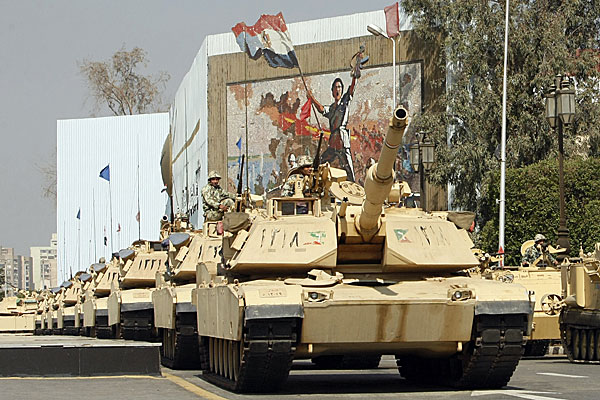
Egyptian army tanks are deployed in front of the monument to the unknown soldier in Cairo on February 17, 2011.(Mohammed Abed-AFP-Getty Images)
There are countless great sources for those following the Middle East’s political clock by the movement of its second- and minute-hands. But for those looking to track the movement of the hour-hand, there are few better options than the New York Review of Books tag-team of Hussein Agha and Rob Malley. The former Palestinian negotiation adviser now at Oxford (Agha) and the former Clinton Administration Mideast adviser now with the International Crisis Group (Malley) have produced a magisterial body of analysis of the state of the Israeli-Palestinian conflict in an ongoing series of essays high in the nutrients of original observation and prescient prognosis. And now they’ve turned their unsentimental attention to the Arab Spring that has shaken up the region stretching from Algeria to Syria and Yemen over the past nine months, warning that the heady optimism of “Twitter revolutions” has given way to a season of Arab counterrevolution.
The regimes targeted in the Arab Spring were products, Agha and Malley note, of the dashed optimism of an earlier era of revolutionary in the decades following World War II, which produced regimes promising to restore Arab dignity through modernization and social justice, yet which became corrupt, authoritarian shells bereft of all legitimacy — or even “authenticity” — and beholden to outside powers. The decrepitude of those regimes eventually forced their own citizens into open rebellion.
In Tunisia and Egypt, they won round one in spectacular fashion. Elsewhere, things got messier, as regimes had time to adapt and shape their response. Violence spread, civil war threatened, foreign powers joined the melee, and centrifugal powers—sectarian, ethnic, tribal, or geographic—asserted themselves.
The Arab awakening is a tale of three battles rolled into one: people against regimes; people against people; and regimes against other regimes.
In most cases, the political momentum and initiative has already shifted from those at the forefront of the revolutionary upsurge who lacked organizational structure, recognizable leadership or a clear strategic perspective — the youthful demonstrators of Tahrir Square, for example — to more established power structures: The remnants of the old regime with deep structures of organized patronage; the security forces; and the Islamist parties whose many years in the field under the cosh of the secret police have given them a certain Bolshevik resilience. And the wider context, the Arab rebellions have become a regional geopolitical battleground for such established power players as Saudi Arabia and Iran, the emergent influentials such as Turkey and Qatar, and Western powers looking to reconfigure their role as a result of U.S. imperial downsizing.
The sense grows that what happens anywhere will have a profound impact everywhere. NATO fought in Libya and helped oust Qaddafi. Iran and Saudi Arabia play out their rivalry in Yemen, Bahrain, and Syria; Qatar hopes to elevate its standing by propelling the Libyan and Syrian opposition to power; in Syria, Turkey sees an opportunity to side with the majority Sunnis yet simultaneously fears what Damascus and Tehran might do in return: could they rekindle Kurdish separatism or jeopardize Ankara’s delicate modus vivendi in Iraq? Iran will invest more in Iraq if it feels Syria slipping away. As they become buoyed by advances in Libya and Syria, how long before Iraqi Islamists and their regional allies rekindle a struggle they fear was prematurely aborted?
The risk of regional conflict fueled by ethnic and sectarian breakdowns in any number of states has risen sharply, with the decisions that will shape events in the hand of cold-eyed men with guns rather than the young people armed only with their cell-phones, their courage and their idealism that dominated coverage of the first wave of protest.
The real action, much to their chagrin, takes place elsewhere. The outcome of the Arab awakening will not be determined by those who launched it. The popular uprisings were broadly welcomed, but they do not neatly fit the social and political makeup of traditional communities often organized along tribal and kinship ties, where religion has a central part and foreign meddling is the norm. The result will be decided by other, more calculating and hard-nosed forces.
Among those, Agha and Malley argue, the best-placed are the military, and the Islamists, who aren’t as tainted by the past as are the generals:
Virtually everywhere they are the largest single group as well as the best organized. In Egypt and Tunisia, where they had been alternatively—and sometimes concurrently—tolerated and repressed, they are full-fledged political actors. In Libya, where they had been suppressed, they joined and played a major part in the rebellion. In Syria, where they had been massacred, they are a principal component of the protest movement.
Living in the wilderness has equipped them well. Years of waiting has taught them patience, the cornerstone of their strategy. They learned the art of survival and of compromise for the sake of survival. They are the only significant political force with a vision and program unsullied, because untested, by the exercise of, or complicity in, power. Their religious language and moral code resonate deeply with large parts of the population.
But, they note, mindful of the alarm they raise in the West — and the fact that recent history shows, in Algeria in 1990 and in the West Bank and Gaza in 2006, that Western powers will happily encourage authoritarian putsches when Islamists win elections — reinforce the patience and caution of the Islamists. Rather than a Bolshevik-like power grab, Agha and Malley argue, “They will build coalitions. They will lead from behind.” That means emphasizing democracy and political pluralism, business-friendly economics and a restraint on confrontation with the West and Israel. And in one of their most interesting observations, they add:
Quietly, the Islamists might present themselves as the West’s most effective allies against its most dangerous foes: armed jihadists, whom they have the religious legitimacy to contain and, if necessary, cripple; and Iran, whose appeal to the Arab street they can counteract by not shunning the Islamic Republic and presenting a less aggressive, more attractive, and indigenous Islamic model.
Indeed, while the secular liberal opposition gets the most attention in Western media, where they can offer an indigenous mirror image to Western values, Agha and Malley write that “In Egypt, Syria, Yemen, and Libya, the most significant future rivalry is unlikely to be between Islamists and so-called pro-democracy secular forces. It might well be between mainstream Islamists and Salafists.” Indeed, the Arab Spring is over. For Agha and Malley, it’s going to look very different from what was imagined in the heady days of Tahrir Square:
The Arab world’s immediate future will very likely unfold in a complex tussle between the army, remnants of old regimes, and the Islamists, all of them with roots, resources, as well as the ability and willpower to shape events. Regional parties will have influence and international powers will not refrain from involvement. There are many possible outcomes—from restoration of the old order to military takeover, from unruly fragmentation and civil war to creeping Islamization. But the result that many outsiders had hoped for—a victory by the original protesters—is almost certainly foreclosed.
Winter is coming.